

Quick answer
For most ecommerce brands, yes. Embedding shipping cost in the product price removes the checkout friction that causes cart abandonment, and condition-based free shipping (a minimum order threshold) is the most margin-safe way to do it. The real risk is not free shipping itself; it is absorbing shipping costs without knowing where the waste is. Carrier billing errors, surcharges, and unclaimed SLA refunds add up to 6 to 20 percent of annual shipping spend that most brands never recover.
Shipping cost sits at the intersection of two decisions that rarely get made together: what to show customers at checkout, and how much of that cost you are actually paying versus recovering.
According to LateShipment.com’s research, brands that audit carrier invoices regularly find that 2 to 8 percent of shipments on any given invoice contain billing errors or unresolved SLA failures, all of which are refund-eligible. The free shipping conversation usually starts and ends at the pricing strategy. The recovery side is where most of the controllable margin actually lives.
Of the many reasons for cart abandonment, the shipping fee is among the biggest. It plays a crucial role in influencing customers’ online purchasing behavior and decision making.
The truth is that today’s customers don’t appreciate a separate cost being added to their products at checkout.
In the current era, customers are spoiled for choice by businesses offering free shipping and faster deliveries. So, should you include the shipping cost in your product price? The answer depends on a few factors.
What does including the shipping cost in the product price entail?
By making the shipping cost part of the product price, you totally blanket your customers from the idea that they are paying an extra amount apart from the product price, and provide the impression they are getting FREE SHIPPING for purchasing from your brand.
And boy is “FREE SHIPPING” a major hook!
According to Berman and Wharton marketing professor Barbara Kahn, there’s a certain psychology behind “FREE SHIPPING” that makes it almost mandatory to include shipping cost in overall product price. Kahn calls it the “pain tax.”
Pain tax: As humans, we have a tendency to segregate gains and take pleasure individually in each positive benefit, but when it comes to dealing with a loss, paying an extra amount for shipping, we’d rather take it in one lump sum. When shipping costs are charged separately, customers perceive them as a loss overall, overlook the benefits of the product they wanted to purchase, and end up abandoning their carts.
Will free shipping impact my margin?
The answer depends on the choices you make.
Giving away shipping 100% free, where you bear the full shipping cost from your margin, can hurt your business unless you charge a premium on your products. Shipping charges are dynamic and differ from location to location. Even the ecommerce giants, who get better shipping rates from shipping carriers, struggle to provide free shipping on all goods because it is still expensive.
To make optimal use of free shipping, you need to get the balance right. Threshold-based free shipping, or condition-based free shipping, where a minimum purchase limit is set, has seen good success among retailers.
In fact, 60% of ecommerce companies cite free shipping with conditions as their most successful marketing tool (as of Q4 2024). On the one hand, it satisfies customers’ need for free shipping; on the other, it increases the Average Order Value (AOV) by motivating customers to meet the threshold.
You can also opt for less expensive shipping options or extended delivery periods. Customers who are not in immediate need of a product will still choose to wait when free shipping is on offer.
What shipping cost is actually made of
Before deciding how much margin to absorb, it helps to know exactly what you are absorbing. Carrier pricing runs across at least four variables simultaneously.
Weight and DIM weight: Carriers charge based on whichever is greater, actual weight or dimensional weight. Dimensional weight is calculated by dividing package volume by a carrier-set divisor. A 10 lb product in an oversized box can be billed at 18 lb or higher. Right-sizing packaging is the fastest way to reduce this cost before a single negotiation.
Shipping zones: FedEx and UPS use eight zones in the US. Zone 1 is close to your warehouse; Zone 8 is cross-country. A single zone shift can increase cost by 20 to 40 percent on the same package. Brands operating from a single fulfillment location pay a structural zone penalty on all national shipments.
Surcharges: The base rate is rarely what you actually pay. Fuel surcharges, residential delivery fees, address correction charges, and peak season surcharges push the final invoice materially above the contracted rate. Fuel surcharges alone have accounted for 15 to 25 percent of total carrier spend during high-volatility periods.
According to LateShipment.com’s research, surcharge-related charges and DIM weight discrepancies together represent the largest share of recoverable billing errors found during carrier invoice audits. Understanding which of these is inflating your per-shipment cost tells you which lever to pull first.
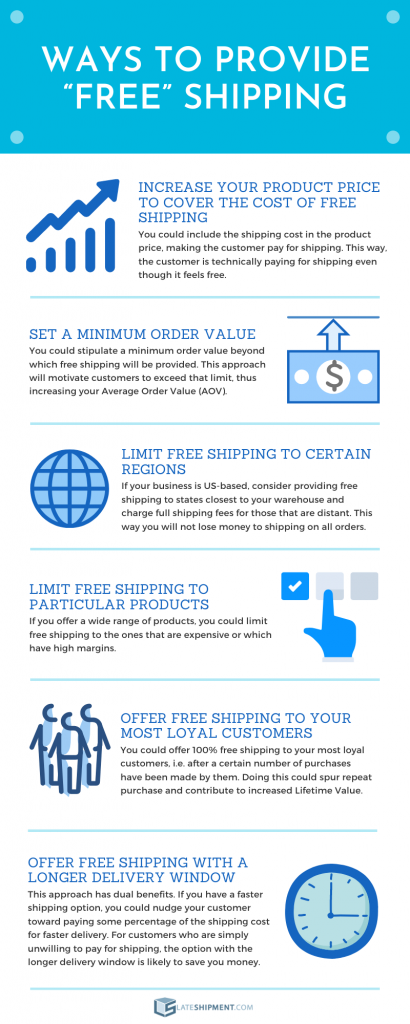
So, what are the different ways of providing “free” shipping?
1. Increasing your product price to cover the cost of free shipping
You could include the shipping cost in the product price, making the customer pay for shipping. This way, the customer is technically paying for shipping, even though it feels free.
2. Setting a minimum order value
You could stipulate a minimum order value beyond which free shipping would be provided. This approach will motivate customers to exceed that limit, thus increasing your Average Order Value.
3. Limiting free shipping to certain regions
If your business is US-based, you could provide free shipping to states closer to your warehouse and charge full shipping fees for the states that are distant. This way you will not lose money to shipping on all orders.
4. Limiting free shipping to particular products
If you offer a wide range of products, you could limit free shipping to the ones that are expensive or which have high margins.
5. Offering free shipping to your most loyal customers
You could offer 100% free shipping to your most loyal customers, i.e. after a certain number of purchases have been made by them. Doing this could spur repeat purchase and contribute to increased Customer Lifetime Value (CLV).
6. Offering free shipping with a longer delivery window
This approach has dual benefits. If you have a faster shipping option, you could nudge your customer toward paying some percentage of the shipping cost for faster delivery. For those customers who are simply unwilling to pay for shipping, the option with the longer delivery window is likely to suffice.
There are a few other approaches you could consider while charging for shipping.
What are the other ways to charge for shipping?
1. Charging real-time carrier rates
All major shipping carriers like FedEx, UPS, USPS, DHL, etc. provide APIs that could be connected with your eCommerce platform. These APIs enable your store to calculate shipping rates live while a customer is purchasing. Shipping rates are calculated based on the product size & weight and origin & destination.
There are two benefits with this approach. Firstly, there won’t be a risk of under charging your customers. Secondly, this will earn you points for transparency.
With this strategy, there is risk of cart abandonment, but it works well if you ship to international destinations with wildly varying shipping charges.
2. Charging a flat rate
Under this strategy, you charge the same rate for all orders. This strategy works best when you have a standard product line with items that are similar in size and weight.
The benefit of offering flat rate shipping is that it makes it easy to communicate the shipping charge to customers. It also encourages customers to order large volumes since the shipping cost does not increase as the number of products in the cart increases.
One obvious disadvantage is that you might lose a few orders, so you must maintain a balance between undercharging and overcharging customers.
There are still other ways to reduce your shipping spend. Read on to learn more.
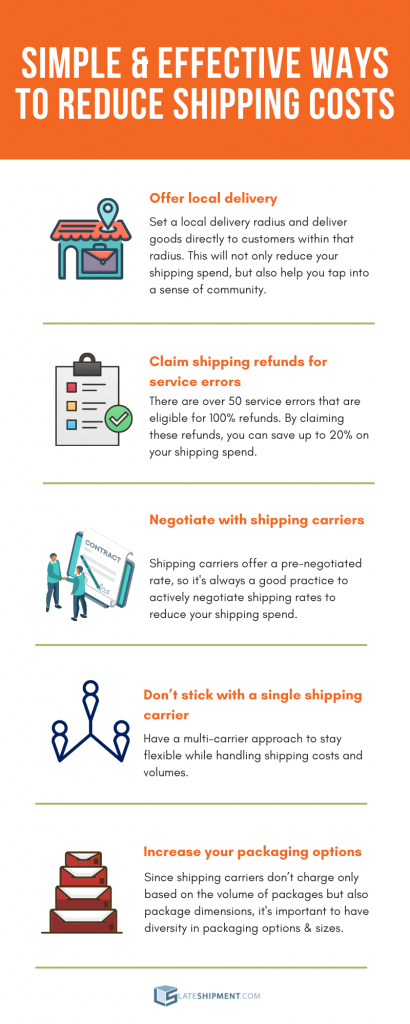
What are some simple & effective ways to reduce shipping costs?
1. Offer local delivery
This could be a simple and reliable way for you to save on your shipping costs. When you set up a local delivery service, you can set a radius within which you want to deliver to your customers. This is quick and cheaper than the traditional way of shipping.
You can maintain a tab over where you are willing to deliver for free, or else charge a low price on deliveries to reduce your shipping spend.
The best thing about handling local deliveries in house is that it allows you to stay connected with your customers throughout the delivery process and helps you build a sense of community.
2. Claim shipping refunds for service errors and billing mistakes
Carriers miss delivery commitments, apply incorrect surcharges, calculate dimensional weight incorrectly, and duplicate charges on invoices. Under their own service guarantee terms, all of these are refund-eligible. The catch is a tight claim window, typically 15 days from invoice date, and a filing process that requires matching every error against your contracted rates at the line-item level.
According to LateShipment.com’s research, brands auditing carrier invoices systematically recover 6 to 20 percent of annual shipping spend. That figure comes from claims across 50-plus refund categories including late deliveries, DIM weight errors, and invalid surcharges. Manual auditing at any meaningful shipment volume is not operationally practical, and most eligible claims expire before finance teams see them.
OneAudit checks every carrier invoice against 160 checkpoints, files claims automatically within the window, and escalates denied claims through human specialist review. Credits post directly to your carrier account. For brands on a performance-based model, there is no cost unless refunds are recovered.
Lost and damaged shipments are a second recovery layer on top of invoice auditing. Most brands resolve the customer side quickly but never file the carrier-side claim. Automating that claim at the point of customer reporting closes the gap between what carriers owe and what brands actually collect.
3. Negotiate with various shipping carriers
Negotiating with shipping carriers for better rates is an important aspect of eCommerce shipping. Generally, major carriers like FedEx UPS, USPS, and Canada Post offer you pre-negotiated rates, but you should always try negotiating with these carriers for a better deal, especially if you are starting out.
While negotiating :
- Have a clear grasp of your shipping data, and use it.
- Know your average shipping volumes and ask for volume discounts.
- Watch out for hidden fees and surcharges.
- Know the types of discounts offered by shipping carriers.
LateShipment.com’s Carrier Performance report gives you access to actionable insights that will provide you leverage while renegotiating rates with your shipping carrier.
4. Don’t stick with a single shipping carrier
A multi-carrier shipping approach gives you the flexibility to choose the carrier that gives you the best rate at any given time. It also provides you the ability to switch carriers when a carrier fails to meet delivery expectations or is facing delivery issues due to high volumes.
Using a single carrier while starting out makes sense, but as your business grows and your delivery volume increases, it would be risky not to have a multi-carrier approach because it could result in delivery issues and increased shipping spend.
5. Increase your packaging options
Since shipping carriers don’t charge only based on the volume of packages but also package dimensions, it is important to have diversity in packaging options. This will help you reduce the price that you may have to pay for the extra space in your packaging.
Space in packages may also increase your package material cost and the risk of damaging your product.
Key takeaways
| Decision / Area | What to do |
|---|---|
| Including shipping cost in price | Embed it for most SKUs to eliminate checkout friction. Use condition-based thresholds to protect margin. |
| Free shipping threshold | Set the minimum order value 20 to 30 percent above your average order value to lift AOV without absorbing full cost. |
| What shipping cost is made of | DIM weight, zone pricing, and surcharges are the three biggest controllable levers before any negotiation. |
| Recovering shipping costs | Carrier billing errors are refund-eligible. Brands auditing invoices systematically recover 6 to 20 percent of annual spend. |
| Lost and damaged claims | Filing the carrier-side claim is separate from customer resolution. Most brands absorb the cost without claiming what carriers owe. |
| Carrier negotiation | Audit data on SLA failure rates and surcharge patterns gives you evidence most brands do not bring to rate negotiations. |
Final Word
While there are different ways and approaches when it comes to dealing with shipping costs. But, as we have seen, adding shipping cost into the product price has the definite benefit of reducing the friction for customers contemplating buying your products. Yes, 100% free shipping can impact your margin, but you can always opt for conditional free shipping, or another option best suited to your business model.