


Quick Answer
“Where is my order?” contacts account for 30 to 40% of total support volume for most ecommerce brands. They are not a support capacity problem. They are a post-purchase communication failure: a customer who received no meaningful update after dispatch and had no self-serve way to find out what was happening. Brands that reduce these contacts do it through proactive delivery communication and branded tracking, not by hiring more agents. The fix is upstream of the support queue.
Every support team knows the pattern. The order shipped. The customer got a dispatch email. Then nothing. No update when the package reached the sort facility. No alert when it was out for delivery. No proactive message when the carrier attempted delivery and failed. Three days after the expected date, the customer opens a ticket: “Where is my order?”
According to LateShipment.com research, order status inquiries account for roughly 35% of total inbound support volume for ecommerce brands shipping at meaningful scale. That figure is not evenly distributed. It spikes during carrier delays, peak season surcharges, and any period when delivery exceptions are running above baseline. The inquiry volume is, in effect, a lagging indicator of your post-purchase communication gaps.
The brands that reduce it are not the ones with the fastest support teams. They are the ones that eliminated the conditions that produce the question in the first place.
Why Order Status Inquiries Happen
The question has one structural cause: the customer has no reliable, real-time visibility into what is happening with their order. Everything else, the specific phrasing, the channel, the tone, is a symptom of that single gap.
But the gap has multiple contributors, and understanding which one is driving your volume is the prerequisite to fixing it.
Sparse or Delayed Carrier Tracking Updates
Carrier tracking data is not real-time in most domestic networks. Updates fire at scan points: sortation facility intake, transfer between hubs, out for delivery, delivery confirmation. Between those events, the tracking page shows nothing new. For a customer who placed an order expecting two-day delivery and sees no update after 36 hours, the rational response is to contact support.
The problem is not that the carrier has no information. It is that the brand’s customer-facing experience does not proactively surface the information it does have, or interpret scan silence as a signal worth communicating about. According to LateShipment.com research, customers engage six times more with a branded tracking experience than with a generic carrier tracking page, because the branded experience is built to answer the question rather than display a status code.
Generic carrier tracking pages
When a customer clicks the tracking link in a dispatch email, most brands send them to a carrier-branded page: a UPS, FedEx, or USPS tracking interface that shows nothing about the brand, has no context about the specific order, and provides no next-step options if something looks wrong. The customer is now looking at a bare tracking number and a status code they may not be able to interpret.
According to LateShipment.com’s research, customers engage six times more with a branded tracking experience than with a generic carrier tracking page. Engagement, in this context, means the customer found what they needed and did not need to contact support.
No Communication When Exceptions Occur
Delivery exceptions, delays, failed delivery attempts, address issues, and held packages, are the highest-risk moments in the post-purchase journey for generating support contacts. They are also the moments when brands most reliably go silent.
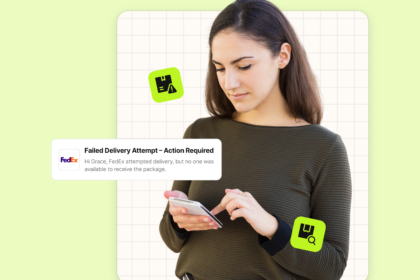
A carrier marks a package as “delivery attempted” and returns it to the depot. The customer receives no notification. Two days later, the customer contacts support asking where their order is. By that point, the package has been sitting at a depot for 48 hours and the customer is already frustrated. The support agent now has to resolve both the logistics issue and the relationship damage.
This is the core failure mode. The exception was detectable. The communication was optional. The support ticket was, in retrospect, entirely predictable.
No self-serve resolution path
Even when a customer gets a tracking update, they often have no action to take if something looks wrong. There is no way to report an issue from the tracking page, no way to request a redelivery, and no way to initiate a claim for a delayed or damaged shipment without opening a support ticket. The tracking page is a dead end.
Support contacts that could be resolved through self-serve flows instead consume agent time. The customer’s experience is worse than it needed to be, and the support team’s cost per contact is higher than it needed to be.
The Real Cost of Order Status Inquiries to Support Teams
The support team cost of order status inquiries is usually modelled as agent time multiplied by ticket volume. That calculation understates the actual cost in two ways.
Handling cost is only part of the equation
A support agent handling an order status inquiry needs to: look up the order in the OMS, check the carrier tracking data, interpret the current status, communicate it to the customer, and log the interaction. For a straightforward inquiry, that takes four to six minutes. For an inquiry involving a delay, an exception, or a shipment with no recent scan activity, it takes longer and often requires a follow-up.
At 35% of total support volume, order status inquiries represent a structural cost inside the support function. For a brand handling 2,000 support contacts per month, that is roughly 700 contacts that exist entirely because the post-purchase communication layer failed.
Repeat contacts compound the cost
Order status inquiries are not always single-contact events. A customer who receives an unsatisfying answer, “we’ll check with the carrier and get back to you,” often contacts support again within 24 to 48 hours. According to research from LateShipment.com, a meaningful share of order status inquiry tickets generate at least one follow-up contact, nearly doubling the effective handling cost per order.
Agent morale and efficiency
Repetitive, low-resolution contacts are the fastest route to agent burnout. An agent whose queue is 35% order status inquiries is spending a third of their day on contacts that add no value to the customer relationship and require no specialist skill to handle. The opportunity cost is the complex, relationship-defining interactions that queue behind them.
The hidden cost: tickets that do not get filed
Support ticket data only captures the customers who chose to contact support. A customer who could not find their order status, waited, and eventually received the order without a satisfying explanation represents a CX failure that never appeared in the queue. These customers are more likely to leave negative reviews, less likely to repurchase, and less likely to recommend the brand. The damage shows up in retention and LTV metrics, not in support cost data.
How Order Status Inquiries Affect Customer Loyalty
The relationship between post-purchase visibility and customer loyalty is not theoretical. It is mechanical: a customer’s willingness to repurchase is determined in part by how they felt during the period between placing an order and receiving it. That period is entirely owned by the post-purchase experience.
The post-purchase moment is a trust signal
Customers extend trust to a brand when they place an order. They hand over payment, contact information, and delivery address, and wait. What happens next is a direct communication of how the brand values their business.
A brand that sends one dispatch email and then goes silent until delivery is telling the customer, implicitly, that their attention stops at the transaction. A brand that sends proactive updates, surfaces exceptions before the customer notices, and provides a self-serve resolution path is communicating ongoing care.
The data reflects this. According to LateShipment.com’s research, brands that implement proactive exception communication see measurably higher CSAT scores even in periods when delivery performance is below baseline, because the communication itself signals that the brand is aware of and acting on the problem.
A difficult delivery does not have to mean a lost customer
The most counterintuitive finding in post-purchase CX is that a delayed delivery, handled well, does not necessarily damage the customer relationship. A delay communicated proactively, with a clear explanation and a resolution option, can actually strengthen trust because the brand demonstrated transparency and competence under pressure.
A delay that surfaces only when the customer goes looking for it, after days of silence, is a different experience entirely. The customer feels ignored, not informed. The retention outcome is correspondingly worse.
Repeat purchase behavior
Post-purchase visibility has a direct relationship with repeat purchase rates. OneTrack’s branded tracking page is the highest-engagement post-purchase touchpoint most brands have: it is visited multiple times per order by customers who are actively thinking about the brand. Brands using OneTrack see a 12% lift in repeat purchase revenue from campaigns surfaced on the tracking page, because it catches customers at peak engagement, not through a cold re-engagement email sent weeks later.
Strategic Comparison: Reactive vs Proactive Post-Purchase Communication
Every support team operates somewhere on the spectrum between fully reactive and fully proactive. The reactive end looks like this: the order ships, the brand sends a dispatch notification, and then the brand waits for the customer to make contact if something goes wrong. The proactive end looks like this: the brand monitors every shipment for exceptions in real time, communicates status changes before the customer asks, and provides a self-serve path for resolution.
| Dimension | Reactive Model | Proactive Model (OneTrack) |
|---|---|---|
| When communication happens | When the customer initiates contact | When a tracking event or exception occurs |
| Information source | Agent looks up carrier data on demand | Platform monitors all shipments continuously |
| Customer experience of delays | Customer discovers the delay by checking tracking or contacting support | Customer receives an alert before they notice the delay |
| Support ticket volume | High (every visibility gap generates a potential contact) | Lower (proactive alerts pre-empt the question) |
| Agent workload | Weighted toward low-value status inquiries | Weighted toward complex, high-value interactions |
| CX outcome on failed deliveries | Damage to trust (customer felt ignored) | Trust maintained (customer felt informed) |
The operational shift from reactive to proactive is not a staffing decision. It is a tooling decision. Reactive models are the default when a brand has no system to monitor shipments between dispatch and delivery. Proactive models require a platform that watches every shipment continuously and triggers communication based on what it observes.
OneTrack monitors shipments across 1,600+ carriers and fires alerts on 13 shipping event triggers and 8 exception triggers. When a shipment is delayed, an exception is flagged, or a delivery attempt fails, the brand’s team knows before the customer does, and the customer receives a notification before they think to contact support.
What proactive communication actually requires
The operational components of proactive delivery communication are:
- Multi-carrier monitoring: Real-time carrier tracking data aggregated across all carriers and service types the brand uses, not just the primary carrier.
- Exception detection rules: Rules that define what constitutes an exception worth communicating: scan silence beyond a threshold, delivery attempt failures, weather holds, address issues, and others. The rules should be configurable by the brand.
- Automated notification triggers: Automated notifications that fire when a rule triggers, without requiring an agent to review the shipment first. Email, SMS, and WhatsApp are the relevant channels for most ecommerce brands.
- Self-serve tracking page: A branded tracking page that the customer can visit between notifications for self-serve status checks. A page that reflects the brand’s identity, shows multi-shipment orders in one view, and provides action options (report an issue, initiate a claim, start a return) reduces the need for any contact.
How Brands Prevent Order Status Inquiries: The Operational Playbook
Set expectations before the order ships
Predictive estimated delivery dates displayed on the product page and at checkout reduce post-purchase anxiety before it starts. A customer who was shown a specific delivery date at checkout has a reference point. A customer who was shown “3-5 business days” has a range that becomes increasingly anxiety-inducing as days pass. OneTrack displays carrier-aware estimated delivery dates at the product page and checkout level, with countdown timers that have been shown to lift pre-checkout conversions by up to 24% as a secondary effect.
Send proactive updates at every meaningful tracking milestone
The dispatch notification is not enough. Customers expect updates when the package enters the carrier network, when it is out for delivery, and when it has been delivered. They especially need updates when something goes wrong.
Branded notifications, sent via the customer’s preferred channel at each event trigger, reduce the information gap that generates order status inquiry contacts. The key word is branded: a notification that comes from the carrier’s system, in the carrier’s format, with no brand context, does less work than one that comes from the brand and reflects the order relationship the customer has with the brand, not with the carrier.
Surface exceptions before the customer notices
The highest-value intervention is exception detection. When a shipment is delayed, held, or has a failed delivery attempt, the brand should know before the customer does and communicate before the customer contacts support.
This requires a platform that monitors every shipment in real time, not one that generates a report after the fact. OneTrack flags shipments that have exceeded a configurable scan-silence threshold, shipments with active delivery exceptions, and shipments that have missed their delivery window, and pushes those flags to the helpdesk so the support team can act or to the customer via automated notification.
Make the tracking page a resolution surface, not just a status display
A branded tracking page that only shows status is a partial solution. The order status inquiry contacts that persist even after proactive notifications are in place are usually from customers who want to do something: report a problem, request a redelivery, initiate a claim, or start a return. If the tracking page has no action options, those customers contact support.
OneTrack’s tracking page integrates returns initiation, lost and damaged claims, and issue reporting directly into the tracking experience. A customer who wants to return an item, or report a delivery problem, does it from the same page where they checked their tracking status. No redirect to a separate portal, no support ticket required.
Is Order Tracking Part of Customer Experience?
Yes. And the framing matters.
Order tracking is often managed as a logistics function: a carrier data feed, a tracking number, a link in the dispatch email. When it is managed that way, the customer experience of the post-purchase journey is shaped by whatever the carrier provides, which is a generic interface designed for the carrier’s operational needs, not the brand’s customer relationship.
When order tracking is managed as a CX function, the question changes from “how do we give customers a way to track their order?” to “how do we maintain the brand relationship between purchase and delivery?” The answer to the second question is a branded, proactive, self-serve post-purchase experience. That is what OneTrack is built to deliver.
The distinction has measurable consequences. Brands that treat post-purchase tracking as a CX function see lower order status inquiry volume, higher CSAT despite delivery exceptions, higher repeat purchase rates, and lower support cost per order. Brands that treat it as a logistics function absorb the inverse of each of those outcomes.
Key Takeaways
| Topic | Key Takeaway |
|---|---|
| Root cause | Order status inquiries are a post-purchase communication gap, not a support capacity problem. The fix is upstream: proactive updates, exception alerts, and a self-serve tracking page. |
| Volume benchmark | Order status inquiries account for 30 to 40% of total support contacts for most ecommerce brands. At scale, this is the single largest driver of avoidable support cost. |
| Support cost | The handling cost is compounded by repeat contacts. A meaningful share of order status inquiry tickets generate at least one follow-up, nearly doubling the effective cost per order. |
| Customer loyalty | A delayed delivery communicated proactively does not necessarily damage the customer relationship. A delay discovered by the customer, after days of silence, usually does. |
| Reactive vs proactive | Reactive models wait for the customer to ask. Proactive models surface the information before the question forms. The shift requires tooling, not headcount. |
| Order tracking as CX | Brands that manage post-purchase tracking as a CX function, not a logistics function, see measurably lower support volume, higher CSAT, and higher repeat purchase rates. |
Frequently Asked Questions
Order status inquiry tickets are a direct signal of a post-purchase CX gap. They indicate that customers have no self-serve way to find out what is happening with their order and no proactive communication from the brand when something changes. Beyond the handling cost, they represent customers who are anxious about an order they cannot track, which damages trust and reduces the likelihood of repeat purchase regardless of whether the order eventually arrives on time.
The interventions that reduce order status inquiry volume are: proactive delivery notifications at every meaningful tracking milestone, real-time exception detection with automated customer alerts when delays or delivery failures occur, a branded self-serve tracking page that customers can check without contacting support, and action options on the tracking page for reporting issues, initiating claims, and starting returns. These are tooling decisions, not staffing decisions.
Yes. The post-purchase period, between order placement and delivery, is a high-engagement window where the customer’s perception of the brand is actively being shaped. A carrier-controlled generic tracking page communicates that the brand’s responsibility ended at dispatch. A branded, proactive, self-serve tracking experience communicates ongoing care. The retention and CSAT outcomes differ accordingly.
Post-purchase visibility has a direct relationship with repeat purchase behavior. Customers who receive proactive updates, including alerts when something goes wrong, report higher satisfaction scores even when deliveries are late, because the communication signals that the brand is aware of and managing the situation. Customers who discover delays by checking tracking themselves, after a period of silence, are significantly less likely to repurchase.
Proactive delivery communication means the brand sends status updates when tracking events occur, rather than waiting for the customer to ask. It includes branded dispatch notifications, in-transit status updates, out-for-delivery alerts, delivery confirmations, and, most importantly, exception alerts when a delay, failed delivery attempt, or other issue is detected. Proactive communication requires a platform that monitors every shipment in real time and triggers notifications automatically when conditions change.
According to LateShipment.com research, order status inquiries account for roughly 35% of inbound support volume for ecommerce brands shipping at meaningful scale. That share rises during peak season, carrier delay periods, and any time delivery exception rates are above baseline. Brands using proactive delivery communication through OneTrack see reductions of up to 72% in delivery-related support contacts.