

Quick answer:
Smart retailers cut return expenses by 40% by attacking costs on three fronts: reducing the volume of low-quality returns through better product data and policy design, converting more returns into exchanges (40% of returns become exchanges when the process is easier than getting a refund), and automating return processing to cut per-return handling time by up to 95%. The hidden cost of returns is not the refund itself: it is the cascade of reverse logistics, inspection, restocking, markdown risk, and opportunity cost that together can eat up to 60% of an item’s original value. LateShipment.com’s OneReturn platform addresses all three cost fronts through self-serve returns, automated routing, and revenue retention tools built into a single system.
Key Takeaways
- The scale of the problem: U.S. retailers are projected to face approximately $890 billion in returns in 2025, representing about 17% of total retail sales. E-commerce return rates hover near 25%, nearly three times higher than in-store returns at 9%.
- The hidden cost multiplier: The refund line is not where returns cost you. It is the cascade of reverse logistics, inspection, restocking, markdown risk, and tied-up inventory that together eat up to 60% of an item’s original value before you issue a single credit.
- Returns are a revenue retention opportunity, not just a cost: 40% of returns could become exchanges if the exchange process were easier than getting a refund. Customers who exchange spend 25% more than their original purchase. Store credit holders spend 15% more per transaction than cash refund customers.
- Data is the primary cost-cutting tool: Retailers who track return reasons at the SKU level, separate legitimate returners from serial abusers, and use root cause analysis to fix product descriptions, sizing charts, or quality control issues can reduce their return rates without restricting policies.
- Automation reduces processing costs: EPØKHE, a premium eyewear brand, reduced return processing time by 95% using LateShipment.com’s OneReturn platform, bringing support time per return from hours to under 2 minutes.
Here’s the thing about retail returns: they’re not going anywhere. But the way you handle them could be costing you a fortune.
The numbers are staggering. U.S. retailers are projected to face approximately $890 billion in returns in 2025, representing about 17% of total retail sales. E-commerce return rates hover near 25%, nearly three times higher than in-store returns at 9%.
What makes this worse?
Every returned item triggers a cascade of hidden costs: reverse logistics, inspection and restocking, potential markdowns for returned merchandise, and the opportunity cost of tied-up inventory. The worst part? An inefficient returns process can eat up to 60% of an item’s original value.
The good news? These rates can be slashed with the right returns management approach.
Are Returns Really Just a Cost Center?
Let’s break down the two biggest myths killing retailers’ return strategies.
Myth 1: Are returns pure cost centers that drain profit?
This thinking ignores the bigger picture. Yes, processing returns costs money upfront, but restrictive return policies cost you far more in lost sales and customer lifetime value. When customers can’t return items easily, they simply stop buying from you altogether. The cost of returns pales compared to the cost of losing customers to competitors with better policies.
Myth 2: Do customers who return products stop buying from you?
It’s a common misconception that when customers return a product, they’re probably not going to buy from you again. But in reality, when your customers can return something as easily as they bought it, you’ve probably made a loyal customer out of them. An easy returns process can boost repeat purchase confidence by 85%.
Great returns don’t have to be expensive. They just need to be smart. But to offer smart returns, you really need to understand where your returns are getting expensive in the first place.
What's Really Driving Your Return Costs?
Most retailers focus on the wrong metrics. They see return rates climbing and panic. But here’s what’s actually bleeding money
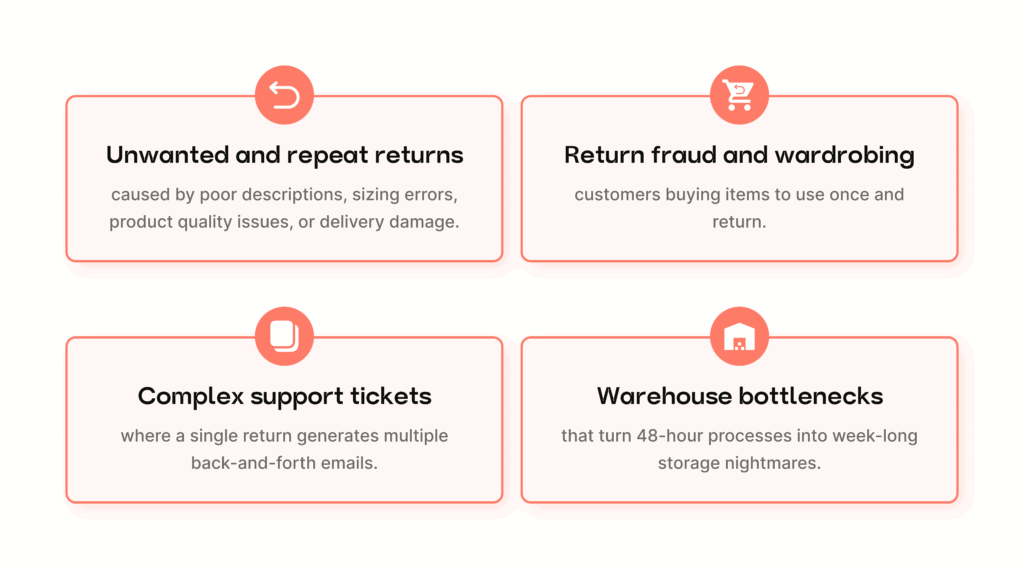
- Inefficient reverse logistics: Manual label generation, disorganized carrier selection, and no routing logic send returns on the most expensive path back to warehouse.
- Processing bottlenecks: Support teams managing returns by email, returns arriving with no pre-attached metadata, and no triage system mean every return requires individual human handling.
- No exchange path at the point of return: When exchange is buried in the process or requires customer effort, refunds happen by default. 40% of returns could become exchanges if the exchange process were easier than getting a refund.
- Policy gaps and fraud: Inconsistent policy enforcement and no detection of serial return behavior let avoidable returns and return fraud pass through without interception.
- No SKU-level data: Without return reason data at the product level, retailers cannot fix the root causes (bad sizing charts, inaccurate product photography, quality issues) that drive high return rates on specific items.
What Data Should Retailers Track to Reduce Return Rates?
The retailers cutting return costs by 40% are not doing it by tightening policies. They are doing it by turning return data into product, operational, and customer intelligence.
Which products have a return rate above 20%, and why?
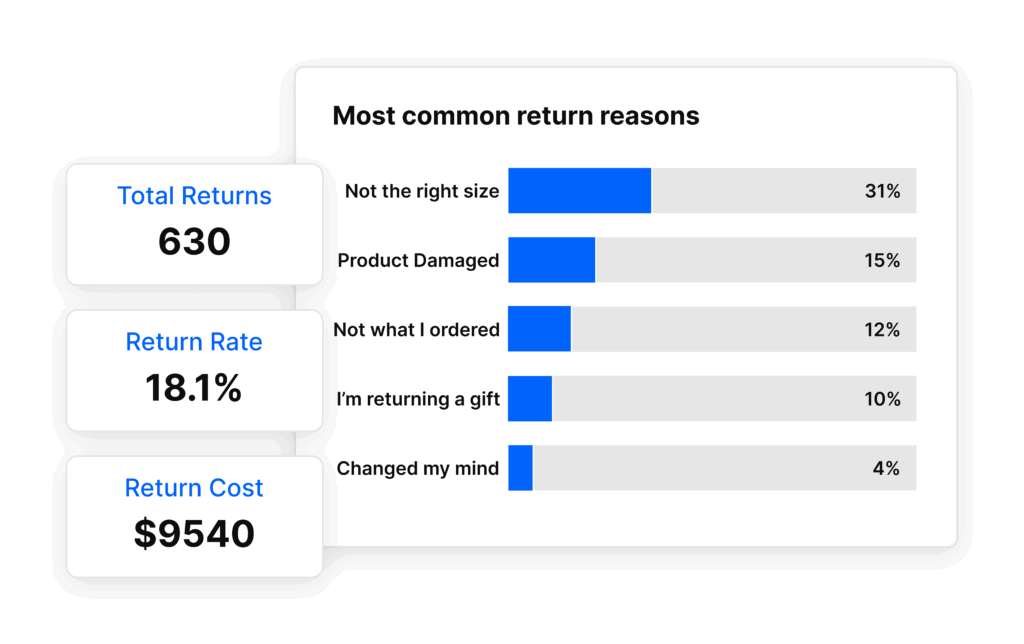
Product-level intelligence reveals which items have return rates above 20%. Track whether customers return because items are ‘too small,’ ‘defective,’ or ‘not as described.’ Each reason points to a different fix: better size charts, quality control, or product photography. A 25% return rate on a specific SKU is a data problem before it is a returns problem.
How do you identify serial returners and return fraud?
Customer behavior patterns separate legitimate returners from serial abusers. Flag customers with suspicious patterns: same address with multiple accounts, return rates that are statistically inconsistent with normal buying behavior, or returns of used items as new. Behavioral segmentation lets you apply different policy rules to different customer tiers without penalizing loyal buyers.
How does root cause analysis turn return pain points into competitive advantages?
Root cause analysis turns return pain points into competitive advantages. If customers keep saying products are ‘not as described,’ your product photos need work. If it’s all sizing issues, your size charts are failing. If it’s defects concentrated on one supplier’s SKUs, that’s a quality control conversation. Each return reason is a data point that tells you where to invest to reduce future return volume.
Should return policy vary by product category?
Policy optimization means different rules for different products. Electronics might get 30 days, seasonal items 14 days, and luxury goods 90 days. One size does not fit all. A returns management platform that automatically applies rules based on product type, price level, and customer group removes the need for manual work and the inconsistencies that happen when relying on support team decisions.
How Do Smart Retailers Turn Returns Into Revenue?
Here is what most retailers miss: customers who exchange spend 25% more than their original purchase. Store credit holders spend 15% more per transaction than cash refund customers.
The secret is making exchanges and store credit more attractive than refunds. Here is how smart retailers do it:
- Offer 10% bonus credit for choosing store credit over cash refund: small incentive, significant revenue retention
- Make exchanges free while charging for return shipping: the default option becomes the revenue-retaining one
- Surface exchange options at the very first step of the returns portal, before refund options, so the path of least resistance is an exchange
- Use exchange incentives that are relevant to the returned product: if a customer returns a size small, show them size medium in stock with free exchange shipping
Small incentives create significant revenue retention. A brand that converts 40% of potential refunds into exchanges or store credit materially changes its returns economics without changing its return rate.
Returns Experience Management with LateShipment.com
This is where Returns Experience Management changes everything.
Self-serve returns and branded tracking enable shoppers to return without hassle through a branded return portal within your storefront. Smart policy compliance automatically enforces return windows and custom rules, while downloadable shipping labels are generated instantly. Automated return status updates via email and SMS keep customers informed with delightful, on-brand experiences, and self-serve lookup lets customers check real-time status directly from your website.
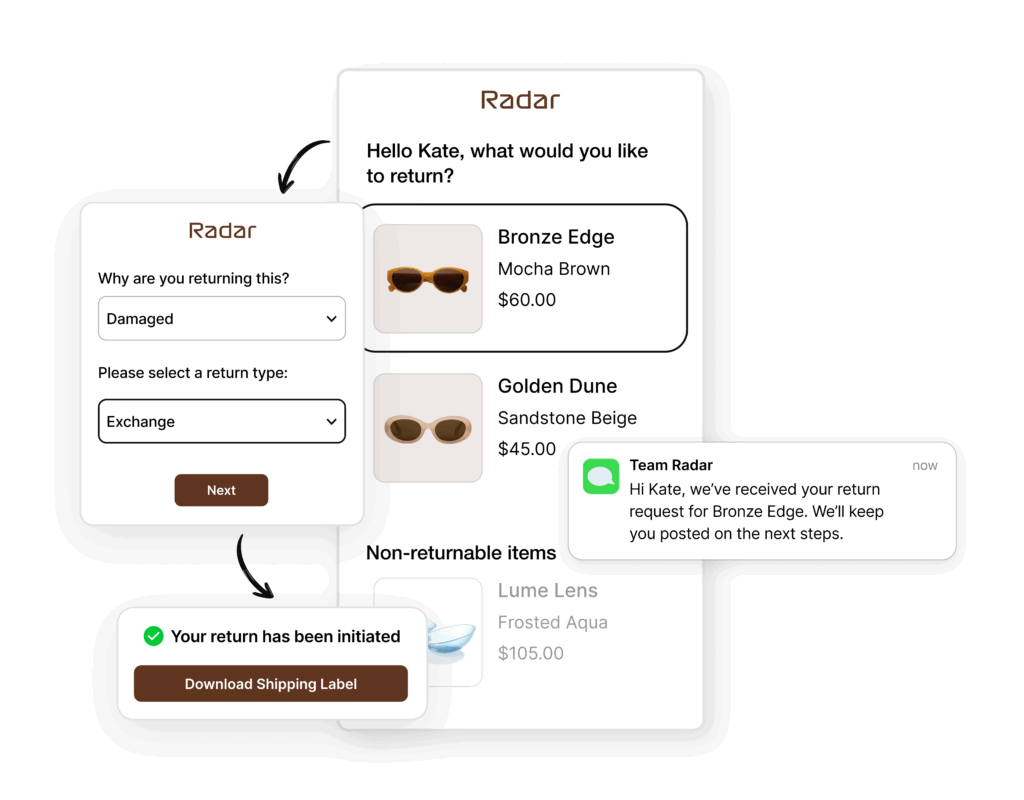
Smart revenue retention and automation turn every return into a revenue opportunity. Seamless exchanges encourage confident repeat purchases, while refund-as-store-credit options secure sales. Bonus incentives make exchanges more attractive than refunds, with compelling discounts and free shipping. Meanwhile, customizable return rules break down complex policies into automated processes, with flexible routing directing returns to the right warehouse automatically.
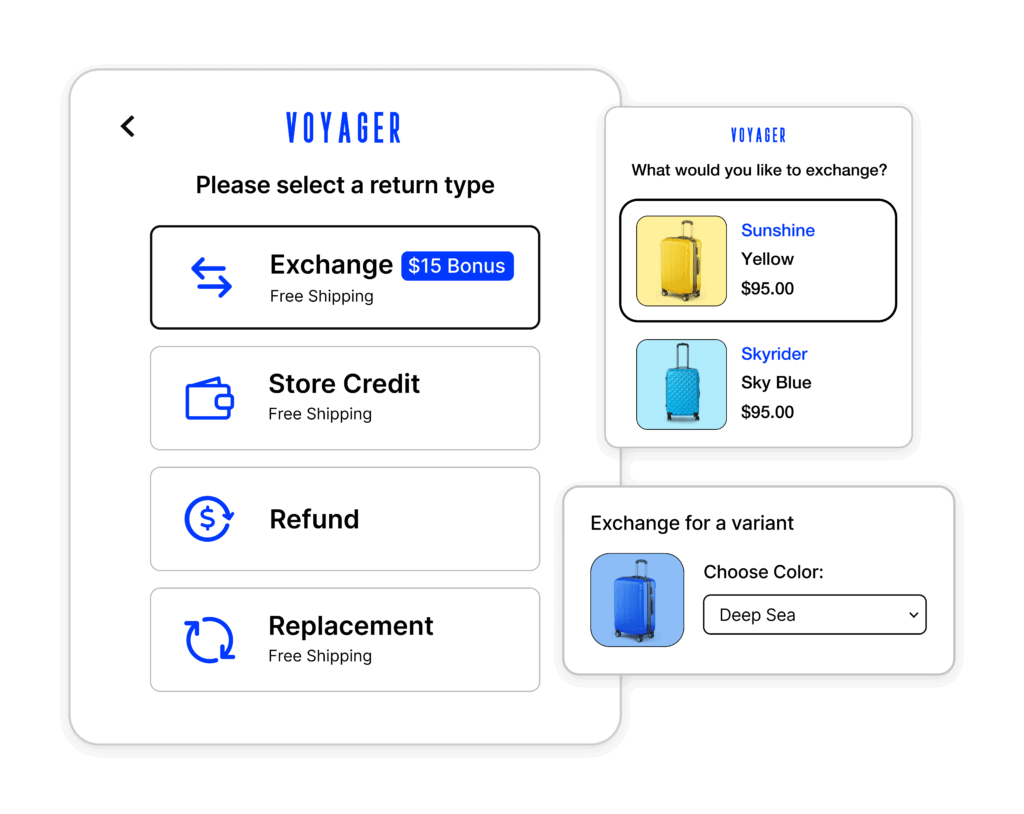
Management tools and intelligence help teams resolve returns faster at scale. Collaborative dashboards enable one-click resolution with every detail readily available, while advanced resolution handles partial refunds and custom deductions with ease. Returns intelligence provides trend analysis to minimize return rates, cost analysis for cutting expenses, process insights for streamlined operations, and customer satisfaction ratings to enhance the return experience.
How EPØKHE Transformed Their Returns Process with LateShipment.com
EPØKHE, a premium Australian eyewear brand, was drowning in manual return processes. Customers filled Google forms, support teams played email tag, and international returns were a nightmare with multiple carriers.
LateShipment.com delivered a comprehensive returns experience change: a user-friendly self-serve portal allowing customers to initiate returns or exchanges with just a few clicks, an enhanced FAQ section on the returns portal providing clear information and reducing customer confusion, and automated shipping notifications through Klaviyo keeping customers informed about real-time return status.
The results: Support teams now spend under 2 minutes per return request, down from hours of back-and-forth. Processing time dropped 95% through automation. What used to be a cost center became a competitive advantage.

Your Competitive Edge: Treating Returns as a Revenue Lever
Returns aren’t just a cost center: they’re a powerful customer experience differentiator. While most competitors see returns as a necessary evil, smart retailers change them into engines of revenue retention and loyalty.
The future belongs to businesses that use data-driven return management to cut costs and raise satisfaction at the same time. When your return process becomes the reason customers stay with you over others, you’ve turned a traditional weakness into a competitive advantage.
The real question isn’t whether you can afford to optimize your returns: it’s whether you can afford not to.
FAQs: How Smart Retailers Cut Return Costs
How much does it cost to process a return for an e-commerce brand?
Processing a return costs between 20% and 60% of the item’s original value when all components are counted: reverse logistics (return shipping), warehouse labor for inspection and grading, restocking or repackaging, markdown risk on items that cannot be resold at full price, inventory opportunity cost during transit and processing, and support team time. For a $60 item, a poorly managed return can consume $12-$36 in processing costs before the refund is issued. Brands that automate return processing with platforms like LateShipment.com’s OneReturn significantly reduce the labor and logistics components of this cost.
What percentage of e-commerce returns can become exchanges?
According to industry data, 40% of returns could become exchanges if the exchange process were made easier than getting a refund. The default behavior for most customers is a refund, not because they want their money back, but because the refund path is clearer and faster. Retailers who put the exchange option first in their returns portal, offer free exchange shipping while charging for refund-only returns, and provide relevant product alternatives at the point of return consistently convert 30-40% of returns to exchanges, each of which generates 25% more spend than the original purchase.
What is the hidden cost of returns in e-commerce?
The hidden cost is everything beyond the refund amount: reverse logistics (typically $5-$15 per package), inspection and grading labor, repackaging and restocking costs, markdown losses on items that cannot be resold at full price, inventory capital tied up during return transit and processing, and support team time. Together, these can consume 20-60% of an item’s original value. Most retailers see only the refund line on their P&L, which understates the true return cost by a significant margin.
How can retailers reduce return rates without hurting the customer experience?
The retailers most effective at reducing return rates do it through better product data, not policy restriction. They track return reasons at the SKU level and fix root causes: if ‘not as described’ is the top reason for a product, the photography or copy needs work; if it’s sizing, the size chart is failing customers. This approach reduces returns on specific high-rate products without making the process harder for customers. Restrictive policies reduce returns on paper but also reduce sales, as 84% of customers will not return to a brand after a negative return experience.
How do I use store credit to retain revenue from returns?
Three tactics work consistently. First, offer a bonus incentive for choosing store credit over cash refund, 10% bonus credit is a common effective level. This turns a refund that leaves your ecosystem into a retained sale. Second, make store credit the default option displayed first in your returns portal, requiring customers to actively choose cash instead. Third, tie store credit issuance to an immediate product recommendation, ideally the replacement for the returned item, so the credit is spent immediately rather than forgotten. Store credit holders spend 15% more per transaction than cash refund customers, making this one of the highest-return revenue retention tactics available.
What is returns experience management, and how is it different from returns management?
Returns management is the operational process of handling physical returns: receiving, inspecting, restocking, and processing refunds. Returns experience management is the customer-facing and revenue-layer built on top of that process: a branded self-serve portal, proactive status notifications, exchange-first workflows, revenue retention incentives, and analytics that feed back into product and policy decisions. The distinction matters because returns management minimizes cost, while returns experience management minimizes cost AND turns the returns touchpoint into a loyalty and revenue driver. LateShipment.com’s OneReturn platform covers both layers in a single system.
Monthly Newsletter
Get practical solutions and insights to tackle real-world post-purchase challenges directly in your inbox