

Quick answer:
Shipping data analytics is the practice of collecting, organizing, and analyzing data generated by carrier shipments: transit times, delivery outcomes, carrier performance, exceptions, and cost per shipment: to measure post-purchase performance and drive operational decisions. For ops teams, it answers the questions that shipping invoices and carrier portals cannot: which carrier is failing at which lane, why WISMO tickets spiked in a given week, where your DIM weight exposure is highest, and whether your carrier SLAs are being met. LateShipment.com’s OneTrack platform automates this data collection and surfaces it in cross-carrier performance dashboards so ops teams can act on it without building reports from scratch.
Key Takeaways
- Post-purchase data is the most underused ops asset: Every shipment generates data: transit time, delivery attempt count, exception type, zone, DIM weight billed, and delivery outcome. Most ops teams only look at this data after a customer complaint. Analytics-led teams review it proactively to spot carrier performance trends before they hit WISMO queues and CSAT scores.
- 8 KPIs drive post-purchase ops decisions: On-time delivery rate, OTIF (on-time in-full), first-attempt delivery rate, transit time variance, carrier exception rate, cost per shipment by zone, WISMO rate, and return rate are the metrics that give ops teams full visibility into post-purchase performance. This guide covers each one.
- Shipping analytics is not the same as website analytics: Website analytics tells you what happens before the purchase. Shipping analytics tells you what happens after. Both matter, but post-purchase data has a direct line to carrier costs, customer satisfaction, and return rates that website analytics does not touch.
- Seasonal demand is predictable with data: December holiday volume spikes and summer lull patterns are visible in historical shipment data. Ops teams with shipping analytics dashboards can prepare carrier capacity, adjust SLAs, and set customer expectations before the peak hits rather than reacting to it.
- Analytics feeds carrier negotiations: On-time delivery rates by carrier, exception frequencies by service level, and cost-per-shipment benchmarks by lane give ops teams the documented evidence to negotiate better carrier contracts. Carriers negotiate differently with customers who arrive with performance data.
What is Shipping Data Analytics?
Shipping data analytics is the collection and analysis of data generated throughout the post-purchase delivery process. This includes data from carriers (tracking events, scan timestamps, delivery outcomes), from your own operations (shipment weight, dimensions, declared value, origin zip), and from customer behavior (WISMO contact rate, post-delivery feedback, return initiation).
The world has recognized that data analytics has answers to questions in every industry. In shipping and logistics, the interdependencies are significant: from the moment a consignment is booked through a carrier, it changes hands and locations across a network involving multiple parties. Shipping data analytics makes those interdependencies visible and measurable.
For ops teams, the question is not whether to track this data but which data to track and what decisions to make from it. Here is the framework.
Why Ops Teams Need Shipping Analytics in 2026
WISMO queries (where is my order?) account for around 70% of post-purchase customer support contacts. Every one of those tickets represents a customer who could not find information they needed without contacting support. Shipping analytics tells you why: which carrier, which lane, which exception type, and which time of year generates the most post-purchase anxiety.
In 2026, carrier billing complexity has also increased significantly. FedEx and UPS now update fuel surcharges on weekly cycles, apply new cubic dimensional triggers, and charge above-average increases on specific weight and zone combinations. Ops teams without analytics dashboards are flying blind on their actual cost structure, often discovering overcharges only when they appear on invoices weeks after the shipment.
Shipping data analytics gives ops teams the tools to answer the questions that matter:
- Which carrier is delivering on-time at which lanes, and which is falling short of SLAs?
- Is our WISMO contact rate increasing, and which shipment type is driving it?
- Are we being billed correctly for the actual dimensional weight of our packages?
- Which exception types (weather, address issues, failed attempts) are most common, and are they concentrated on specific carriers or service levels?
- How does our cost per shipment compare across carriers, zones, and weight bands?
Related: What is WISMO and How to Reduce It -> lateshipment.com/blog/wismo/
The 8 Shipping KPIs Ops Teams Should Track
Not all shipping data is equally useful. These are the eight KPIs that give ops teams a complete view of post-purchase performance:
| KPI | What It Measures | Why It Matters for Ops | Benchmark to Target |
|---|---|---|---|
|
On-Time Delivery Rate |
Percentage of shipments delivered on or before the carrier-committed delivery date |
Primary indicator of carrier performance and a leading signal for WISMO spikes. Drops below the threshold should trigger a carrier performance review. |
>95% for ground services; >98% for express |
|
OTIF (On-Time In-Full) |
Percentage of orders delivered on time and complete with no missing items or damage. |
Combines delivery timing and order integrity. A fuller picture of whether the post-purchase promise was kept. |
Varies by category; >90% is a common B2B target |
|
First-Attempt Delivery Rate |
Percentage of shipments successfully delivered on the first delivery attempt |
Each failed attempt adds a re-delivery cost, a delay, and typically a WISMO or complaint ticket. Low first-attempt rates signal address data quality issues or signature-option mismatches. |
>92% for residential; >97% for commercial |
|
Transit Time Variance |
Difference between promised transit time and actual transit time, measured in days or hours. |
Identifies carriers or lanes where actual performance diverges from contracted SLAs. High variance makes EDD accuracy impossible. |
Less than 0.5 days average variance on standard ground. |
|
Carrier Exception Rate |
Percentage of shipments experiencing a delivery exception (weather delay, address issue, failed attempt, damage). |
Tracks operational friction. Exceptions that resolve quickly are less damaging than those that linger. Segment by exception type to identify root cause. |
Varies significantly; track trend over time rather than absolute number. |
|
Cost Per Shipment by Zone |
Total carrier cost (base rate + all surcharges) divided by shipment volume, segmented by delivery zone. |
The only way to understand true shipping economics. Zone-level data reveals where rate increases are biting hardest and where zone-skipping or warehouse repositioning would save money. |
Compare against prior period; model against carrier rate guide. |
|
WISMO Rate |
Percentage of delivered orders that generated a Where Is My Order support contact before delivery. |
Direct measure of post-purchase anxiety and self-service failure. A rising WISMO rate before any increase in order volume signals a carrier performance or notification problem. |
<3% of orders as a general e-commerce benchmark. |
|
Return Rate by Carrier / Lane |
Percentage of shipments returned, segmented by carrier and delivery geography |
High return rates on specific lanes may indicate delivery damage, not product issues. Analytics separates the two. |
Varies by category; track segmented by reason code. |
How to Use Shipping Analytics to Improve Post-Purchase Performance
How does shipping data reduce WISMO tickets?
WISMO tickets peak when customers have no self-service way to find shipment status, and when delivery is taking longer than expected. Shipping analytics identifies both problems: it flags carriers and lanes with above-average transit time variance so ops teams can proactively adjust EDDs and notify customers before they contact support. LateShipment.com merchants who use proactive notification workflows driven by shipping analytics report up to 72% fewer WISMO tickets.
Related: 15 Proactive Shipping Notifications to Cut WISMO -> lateshipment.com/blog/shipping-notification/
How does shipping analytics support carrier negotiations?
Carrier contract negotiations happen on the carrier’s terms unless ops teams arrive with documented performance data. Shipping analytics gives you that data: on-time delivery rates by service level across 12+ months, exception frequencies by carrier and lane, cost-per-shipment benchmarks by zone. When you can show a carrier that their on-time rate on your account is 87% against a contracted 95%, and back it with documented shipment records, the negotiation changes.
LateShipment.com’s OneTrack platform generates cross-carrier performance reports that are built specifically for this use case: tracking on-time rates, exception rates, and cost benchmarks across all carriers in a single dashboard. Merchants who use this data to inform carrier negotiations typically reduce annual carrier spend by 10-18%.
How does shipping data help manage seasonal demand?
Shipping data from prior years is a reliable predictor of seasonal patterns. December holiday volume spikes, summer delivery slowdowns, and regional weather-related exception clusters all show up in historical shipment data. Ops teams with analytics dashboards can use this data to: negotiate temporary capacity agreements with carriers ahead of peak, adjust EDD promises during high-volume periods, pre-position inventory in regional fulfillments to reduce Zone 7-8 exposure, and plan customer communication cadences around known exception risk windows.
The original insight from data analytics in shipping still holds: if data points to bottlenecks during peak season, you can plan around them from your end. You can decide when to run discount sales, when to offer free shipping, and when to set conservative delivery promises. The difference is that in 2026, this is no longer a manual exercise: it is automated through platforms that surface these patterns in real time.
How does shipping analytics reduce shipping errors and losses?
Past shipment data: transit conditions, exception types, carrier performance by route: helps ops teams identify when to add shipping insurance, which carriers have higher damage rates on fragile product categories, and which address patterns consistently trigger re-delivery attempts. As an end user of a shipping carrier you cannot eliminate package losses directly, but you can use past data to know when to insure packages, which carrier to use for high-value or fragile SKUs, and which lanes need address verification before shipment.
How LateShipment.com's OneTrack Delivers Shipping Analytics
LateShipment.com’s OneTrack platform is the delivery experience management tool built specifically for this workflow. It connects to all major carriers. FedEx, UPS, USPS, DHL, and 1,200+ others: and aggregates shipment data in real time across every order.
For ops teams, OneTrack provides:
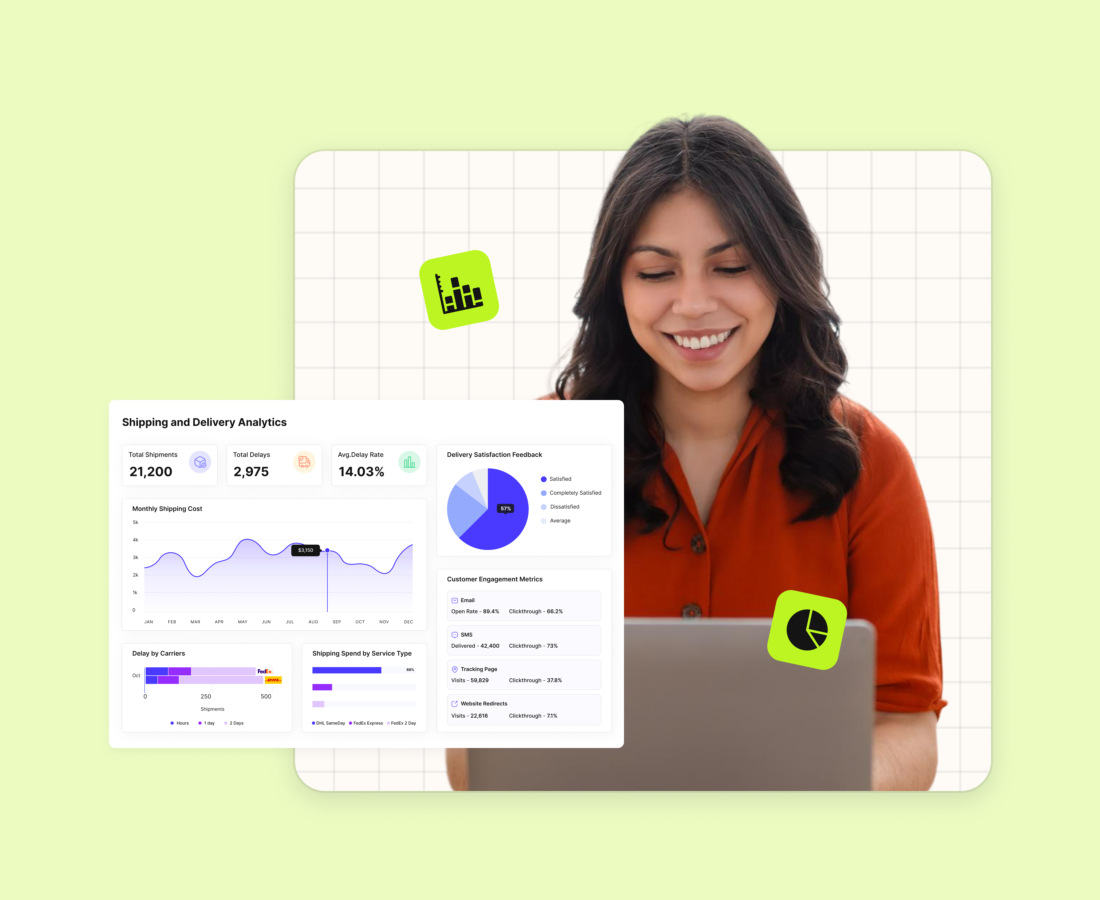
- Cross-carrier performance dashboards: On-time delivery rates, exception rates, and transit time variance by carrier, service level, and lane. Exportable for carrier reviews and contract negotiations.
- Proactive exception alerts: Automated detection of shipments at risk of delay or delivery failure before customers contact support, enabling proactive outreach rather than reactive resolution.
- Cost-per-shipment analytics: Actual spend by zone, weight band, and service level, tied to invoice data from the parcel audit layer. Ops teams see where their shipping budget is actually going, not where the carrier says it is going.
- Branded tracking page with delivery feedback: Customer-facing delivery status with post-delivery feedback capture, feeding delivery satisfaction data back into the performance analytics loop.
Book a product tour: lateshipment.com/product-tour/delivery-experience-management/
Related: What is Delivery Experience Management -> lateshipment.com/blog/delivery-experience-management/
Conclusion
Shipping data analytics is no longer a back-office reporting task. In 2026, it is the operational infrastructure that separates e-commerce brands that react to delivery problems from those that predict and prevent them.
The data is already being generated by every shipment your business makes. The question is whether you are using it to improve on-time delivery rates, reduce WISMO tickets, negotiate better carrier contracts, and plan for seasonal peaks, or whether it is sitting in carrier portals and invoice files untouched until a customer complaint forces you to dig it up.
LateShipment.com’s OneTrack platform makes shipping analytics accessible without custom development or data engineering. Connect your carriers, and your post-purchase performance data is organized, surfaced, and ready to act on.
FAQs about Shipping Data Analytics
What is shipping data analytics?
Shipping data analytics is the collection and analysis of data generated throughout the post-purchase delivery process: carrier tracking events, transit times, delivery outcomes, exception types, cost per shipment, and customer contact rates. For ops teams, it translates raw carrier data into KPIs (on-time delivery rate, WISMO rate, first-attempt delivery rate, exception rate) that measure post-purchase performance and identify where to improve.
What KPIs should ops teams track for post-purchase shipping performance?
The eight most important are: on-time delivery rate (target >95% for ground), OTIF (on-time in-full), first-attempt delivery rate (target >92% residential), transit time variance, carrier exception rate, cost per shipment by zone, WISMO rate (target <3% of orders), and return rate by carrier and lane. Together these cover the full post-purchase performance picture from delivery reliability to customer satisfaction to cost structure.
How does shipping data analytics reduce WISMO tickets?
WISMO tickets spike when customers cannot find shipment status without contacting support, and when deliveries take longer than the EDD promised. Shipping analytics identifies carriers and lanes with above-average transit time variance, enabling ops teams to proactively adjust delivery promises and send status notifications before customers reach out. LateShipment.com merchants using proactive exception-triggered notifications report up to 72% fewer WISMO tickets.
How can shipping analytics help with carrier contract negotiations?
Carrier contracts are negotiated most effectively with documented performance data. Shipping analytics generates on-time delivery rates by service level, exception rates by carrier and lane, and cost-per-shipment benchmarks by zone across your actual shipment history. When you can show 12 months of on-time delivery data and compare a carrier’s actual performance to their contracted SLA, you have use. LateShipment.com’s cross-carrier performance reports are built for exactly this use case.
How does shipping data analytics help with seasonal demand planning?
Historical shipment data reveals seasonal patterns: December volume spikes, summer slowdowns, regional weather exception clusters, and carrier capacity constraints that repeat year over year. Ops teams with analytics dashboards can use this data to negotiate carrier capacity ahead of peak season, adjust EDD promises during high-volume periods, pre-position inventory to reduce long-haul zone exposure, and build customer communication plans around known exception risk windows.
What is the difference between shipping analytics and website analytics?
Website analytics (Google Analytics, Shopify Analytics) measures what happens before and during the purchase: traffic sources, conversion rates, cart abandonment, and checkout behavior. Shipping analytics measures what happens after the purchase: delivery outcomes, carrier performance, exception rates, WISMO contacts, and post-delivery satisfaction. Both matter, but shipping analytics has a direct line to carrier costs, customer retention, and return rates that website analytics does not touch.
What platforms provide shipping data analytics for e-commerce?
LateShipment.com’s OneTrack platform is purpose-built for this use case, connecting to 1,200+ carriers and providing cross-carrier performance dashboards, exception alerts, cost-per-shipment analytics, and branded tracking with delivery feedback. Setup requires no developer resources and works across Shopify, WooCommerce, Magento, BigCommerce, and custom platforms. The OneAudit product adds a parcel audit layer that connects cost analytics to invoice data for full shipping spend visibility.
Monthly Newsletter
Get practical solutions and insights to tackle real-world post-purchase challenges directly in your inbox