



The warehouse floor is a highly visible, tangible metric of scale. When a facility is moving tens of thousands of packages a day, the physical operation demands immediate attention—the forklifts, the pallet wrapping, the endless conveyor belts. However, at the massive scale an operation like XB Fulfillment functioned on, the physical movement of goods was only half the equation.
The much more complex, and often invisible, challenge was managing the data lifecycle for every single tracking number.
Within a large-scale 3PL environment, different teams naturally end up operating in information silos. A Warehouse Management System (WMS) is brilliantly designed to handle internal routing—picking, packing, and manifesting. But the moment a package is handed over to a carrier network, the WMS loses its line of sight. The tracking number essentially becomes a black box until a final delivery scan appears days later.
To solve this visibility gap, LateShipment.com operated as the underlying data connector. We didn’t rip and replace their existing physical workflows or plug directly into their merchant store pages. Instead, we operated purely as an agnostic API connector, reading and writing the critical order and tracking data to bridge the gap between their WMS and the carrier networks. This architecture created a single, unbiased source of truth for every department, completely transforming how they handled the shipment lifecycle.
Here is how that infrastructure has changed the daily realities for the teams on the front lines.
Operations: Enforcing Accountability at the Dock Door. For operations managers, the most chaotic moment of the day is the carrier handoff. Carriers frequently pull up, load massive trailers, and drive off without immediately scanning the inventory into their network. From a data perspective, those packages simply disappear, instantly compromising service level agreements before the journey has even begun.
To combat this, the operations team relied on a Carrier Handoff Exception Report. Instead of a generic list of shipments, this provided a real-time ledger isolating the exact packages that were physically gone but digitally invisible because they lacked an initial pickup scan. They stopped guessing whether a truck had left and started holding carrier representatives accountable on the spot, rectifying missed scans before they snowballed into measurable transit delays.
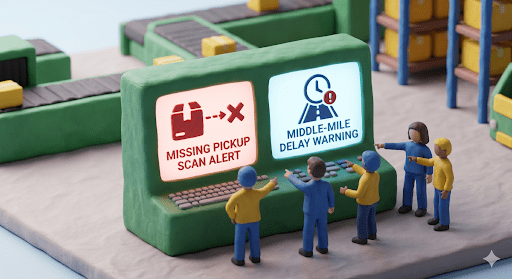
Customer Support: Proactive Exception Management Customer support in the logistics space is traditionally a deeply reactive, high-stress job. Agents spend their shifts responding to anxious customers’ tickets, who have already noticed a problem. Our connector flipped this dynamic, giving the support team the operational foresight they desperately needed.
Using a Middle-Mile Stagnation Alert, the support team identified packages that had been stalled in the carrier network for over 48 hours without a single tracking update. They saw these roadblocks days before the end-consumer realized there was an issue. For high-value expedited orders, an Expedited SLA Failure Tracker isolated guaranteed deliveries that had already missed their promised transit windows.
Instead of walking into a shift blind, support agents used this data to manage expectations proactively. They could reach out to merchants or consumers with solutions and status updates, rather than just apologizing for surprises they couldn’t see coming.
The Post-Journey Audit: Reclaiming Margin in High-Volume Logistics
A tracking number’s lifecycle absolutely does not end when the package reaches the customer’s doorstep. For the financial and strategic teams managing a high-volume 3PL or an enterprise merchant, the most critical phase of the journey actually happens next.
Audit and financial reconciliation come at the end, when the in-transit journey officially concludes, and the merchant is invoiced by the carrier. Without an independent, deep-data layer, companies are entirely reliant on the carrier’s automated sorting machines and internal billing systems. Trusting the entity that is billing you to audit itself is a fast track to margin erosion.
Finance: Auditing the Carrier Invoice Carrier invoices are notoriously dense, highly complex, and inherently prone to systemic errors. The finance team utilized our deep-data connector to execute precise, automated audits after the deliveries were completed.

- Dimensional Weight Adjustments: Carriers frequently issue massive upcharges based on automated volumetric scans that occur mid-transit. A Volumetric Discrepancy Audit served as the finance team’s unbiased referee. It automatically flagged variances between the exact package dimensions passed through the API at the time of manifesting and the dimensions the carrier ultimately decided to bill for.
- Process Friction and Ghost Labels: In any fast-paced warehouse facility, shipping labels are frequently reprinted, voided, or changed at the last minute. A Duplicate Tracking Number Audit automatically identified these overlaps to prevent double-billing. Furthermore, an Unscanned Postage Recovery Ledger tracked labels that were generated and paid for, but never actually entered the carrier network. This streamlined the recovery of thousands of dollars in unused postage that would otherwise be permanently lost.
Strategy: Negotiating with Raw Data. When the time came to negotiate annual carrier contracts or discuss volume discounts, the executive strategy team required hard leverage. Anecdotal feedback from the warehouse floor or glossy performance dashboards provided by the carriers themselves was not enough.
They brought our Network-Wide SLA Compliance Dashboard to the table. Because our infrastructure tracked the lifecycle of every tracking number independently, the strategy team possessed an unvarnished, empirical look at the carrier’s actual performance. They utilized a Service Level Distribution Breakdown to see exactly where their volume was concentrated, and a Carrier Failure Analysis to pinpoint regional bottlenecks and pinpoint exact on-time delivery failure rates.
This raw data provided the exact leverage needed to hold carriers to their promised standards and negotiate vastly better rates.
The Universal Connector. The data infrastructure that powered these teams at XB Fulfillment is not exclusive to a single environment. Because LateShipment.com functions as an agnostic API connector, this exact level of deep-data visibility and post-journey auditing can be plugged into any 3PL operation.
The physical capacity to house merchants will always be a baseline requirement. But for the 3PLs absorbing displaced brands today, the true differentiator—the tool that actually keeps those accounts long-term—is the ability to master the data behind the box.