


Quick answer:
UPS announced a 5.9% General Rate Increase (GRI) effective December 22, 2025, making it the third consecutive year at that headline figure. FedEx announced the same 5.9% average increase, effective January 5, 2026. Both carriers also introduced new dimensional and cubic volume criteria for Additional Handling and Large Package surcharges, which means the real-world cost increase for many shippers runs between 8-12%, not the headline 5.9%. The UPS GRI applies across Ground, Air, and International services. For e-commerce brands, the most impactful changes are the new cubic volume surcharge thresholds (above 10,368 cubic inches for Additional Handling, above 17,280 cubic inches for Large Package) and UPS’s earlier effective date, which gave carriers two additional weeks of higher rates during peak season.
Key Takeaways
- UPS GRI effective date 2026: December 22, 2025: applied to Daily Rates and Small Business Rates across UPS Ground, Air, and International services. This was implemented before the peak holiday shipping window, meaning December 2025 shipments were already subject to 2026 rates.
- FedEx GRI effective date 2026: January 5, 2026: applied to U.S. package services, exports, and imports at an average 5.9% across most services. FedEx Ground Economy, Ground Multiweight, International Premium, and International Priority DirectDistribution also increased.
- 5.9% is an average, not a floor: The actual rate increase for your business depends on your specific shipment mix. Zones 45-46 at UPS saw increases of 5.57%. Lightweight packages (0-5 lbs) saw increases of 5.63%. UPS Next Day Air Saver is up 6.51%. Surcharges. Additional Handling and Large Package: increased 7-9% across most zones, with a new Zone 7 fee tier for Large Package.
- New dimensional volume thresholds expand surcharge exposure: Both FedEx and UPS introduced new cubic volume criteria for Additional Handling surcharges (above 10,368 cubic inches) and Large Package surcharges (above 17,280 cubic inches). Both carriers now round fractional inches up when measuring, which effectively increases billable DIM weight. More of your packages will qualify for these surcharges in 2026 than in 2025, even if their dimensions haven’t changed.
- The overcharge recovery window opens with every rate change: Rate transitions are when billing errors peak. Carriers sometimes apply the new surcharge tier to packages that don’t meet the new criteria, or fail to apply contracted discounts against the updated base rates. Auditing your first 60-90 days of post-GRI invoices through OneAudit is the highest-ROI action item for ops teams after any GRI takes effect
Introduction To The Rate Increase By Fedex And Ups In 2026
Every January, shippers brace themselves for the annual General Rate Increase (GRI) announcements from FedEx and UPS. These changes often reshape logistics budgets for the year ahead, and 2026 is no exception.
FedEx has already confirmed an average 5.9% increase across most U.S. package, export, and import services effective January 5, 2026, along with notable changes to surcharges and dimensional rules.
UPS announced a matching 5.9% GRI effective December 22, 2025: two weeks ahead of FedEx, making it the third consecutive year both carriers have aligned on the 5.9% headline figure.
Why Are FedEx and UPS Rates Increasing Year-Over-Year?
FedEx and UPS have long followed a pattern of annual hikes, typically in the 4.9–6.9% range. On the surface, these increases reflect inflation and rising operational costs such as labor, fuel, and technology investments. But the story runs deeper.
Parcel carriers are grappling with the complexity of residential deliveries, longer last-mile routes, and diverse package profiles. They’re also under pressure to improve margins, which often leads to targeting specific areas of their network where demand is high or costs are harder to control. In practice, that means the headline figure—5.9% in 2026 rarely tells the full story. The real impact depends on a shipper’s package sizes, service levels, and the zones they ship into.
For UPS, the official announcement confirmed a 5.9% average increase effective December 22, 2025. The full breakdown: including service-level splits, surcharge increases, and the new dimensional rules: is covered in the UPS section below.
FedEx Rate Increase Details for 2026
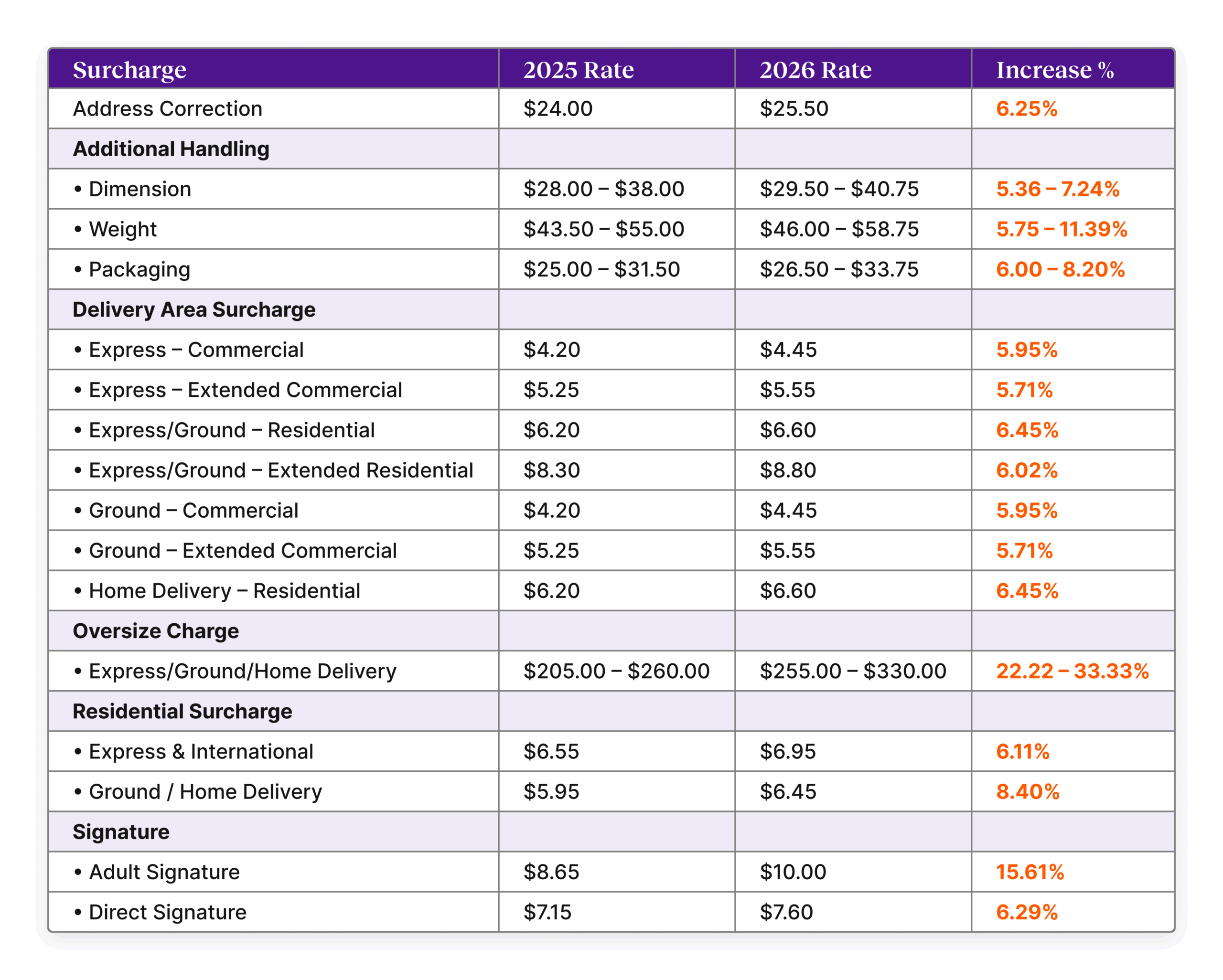
Below is a detailed view of what the FedEx 2026 GRI entails and why the “5.9% average” headline conceals more complexity.
Base Rate & Freight
The standard list rates for U.S. package services, exports, and imports will increase by an average of 5.9% starting January 5, 2026.
FedEx Ground Economy, Ground Multiweight, International Premium, and International Priority DirectDistribution will also see increases (though FedEx has not published a precise percentage for all those services).
Freight rates will increase by either 5.9% or 6.9%, depending on the freight service.
Notably, FedEx Freight box rates will not increase.
Surcharges, Fee Changes & Structural Adjustments
This is where impact can deviate sharply from the base rate increase:
- Minimum Charge: The FedEx Ground minimum charge increases from $11.32 → $11.99, effectively nullifying discounts for very light shipments.
- Residential Surcharge: Rising by roughly 8.4%, this surcharge will more heavily burden e-commerce and home delivery shipments.
- Delivery Area (Remote / Rural Zones): These surcharges will also rise, especially in harder-to-serve ZIP codes.
- Additional Handling / Oversize / Dimensional Rules:
- Beginning January 12, 2026, the criteria for Additional Handling – Dimension will expand to include cubic volume (not just linear measurements).
- Oversize charges will also be assessed using both volume and weight thresholds.
- Services such as Appointment Home Delivery, Evening Home Delivery, and Date–Certain Home Delivery will shift from a per-shipment fee to a per-package model, which may increase costs for multi-box orders.
- Beginning January 12, 2026, the criteria for Additional Handling – Dimension will expand to include cubic volume (not just linear measurements).
- Accessorial & Other Surcharges: Address Correction rises from $24 → $25.50 (6.25%), along with moderate hikes to inbound processing and packaging surcharges.
Weight Effects & Distribution
Industry analysis shows that middle-weight (11–20 lb) packages will see particularly steep increases higher than average. Long-distance shipments also endure above-average increases. For light, short-distance packages, the higher minimum charge may eliminate many negotiated discount benefits.
In other words, while many shippers might see ~5–7% increases, those shipping to remote zones or using surcharges extensively could face effective increases in the 8–12% range. This is not FedEx’s official figure but is widely observed in industry modeling.
UPS Rate Increase Details for 2026
UPS announced its 2026 General Rate Increase on October 30, 2025. The effective date is December 22, 2025, making it the earliest GRI effective date in recent memory and two weeks ahead of FedEx’s January 5, 2026 start. This timing gave UPS higher rates during the final stretch of peak shipping season.
Like FedEx, the 5.9% headline figure is an average. The actual increase varies by service level, shipment weight, and zone, and the surcharge changes compound the headline rate meaningfully.
What is the UPS general rate increase for 2026?
UPS’s 2026 GRI is a 5.9% average increase across Ground, Air, and International services, effective December 22, 2025. This is the third consecutive year UPS has applied a 5.9% GRI. However, the rate change is not uniform across the board.
| UPS Service Category | Average 2026 Increase | Key Notes |
|---|---|---|
|
UPS Ground (domestic) |
5.26% average |
Varies by zone. Zone 45-46 sees the steepest ground increase at 5.57%. Zone 3 at 5.34%. |
|
UPS Ground (0-5 lb shipments) |
5.63% |
Lighter packages see above-average increases. |
|
UPS Ground (11-80 lb shipments) |
Above 5.9% |
Mid-weight band sees among the steepest increases. |
|
UPS Air services (express) |
Varies by service |
Two-day air services see increases above 5.9% across most weight categories. |
|
UPS International |
5.9% average
|
Same headline rate as domestic; surcharge structure changes apply internationally as well. |
|
UPS Large Package Surcharge (LPS). Commercial |
Increased |
UPS remains approximately 13-14% cheaper than FedEx for LPS Commercial shipments. |
What are the key UPS surcharge changes for 2026?
Beyond the base rate, these surcharge changes have the largest practical impact for e-commerce operations teams:
- Additional Handling – Cubic Volume threshold: Effective January 26, 2026, the cubic volume limit for Additional Handling rises from 8,640 to 10,368 cubic inches. UPS will apply both length + girth and cubic volume thresholds. Packages above 10,368 cubic inches trigger the surcharge even if they don’t exceed the length + girth threshold.
- Large Package Surcharge – new cubic threshold: Packages exceeding 17,280 cubic inches or weighing above 110 lbs now trigger the Large Package Surcharge. This matches FedEx’s effective threshold change.
- Fractional inch rounding: UPS will now round up any fractional inch in package measurements, effectively increasing dimensional weight across a wide range of shipments that previously fell just below surcharge thresholds.
- Area surcharges: UPS updated the ZIP codes subject to area surcharges effective December 22, 2025. More ZIP codes now qualify for delivery area surcharge billing.
- Printer Rental Fee: Increased from $3.00 to $9.99 effective December 22, 2025: a 233% increase on this specific fee.
The cubic volume formula: length (inches) x width (inches) x height (inches) = cubic inches. A package measuring 22 x 22 x 22 inches = 10,648 cubic inches, which now triggers the Additional Handling Surcharge under the new UPS threshold. Previously, the same box at 8,640 cubic inches would have cleared the old threshold.
How E-Commerce Businesses Can Prepare for the Rate Increase
It is without a doubt that the service rate hikes by FedEx and UPS will definitely impact the spending threshold of all businesses that ship. However, it’s no time to panic! There are definite ways to help mitigate the impact and even turn this tide into an opportunity to reduce shipping costs.
Strategies for Mitigating the Impact on Shipping Costs
One of the quickest ways to control costs is to pay attention to packaging. With FedEx expanding cubic-volume rules, even trimming a few inches off box size can keep you clear of surcharge thresholds. Businesses that ship multiple parcels per order should also rethink fulfillment logic, since per-package fees will now matter more. In some cases consolidating parcels helps, while in others splitting differently reduces dimensional penalties.
Considerations for Renegotiating Shipping Contracts
GRIs make carrier contracts more critical than ever. Instead of relying only on percentage discounts, e-commerce brands should negotiate waivers or lower minimum charges if many shipments fall under that floor. Asking for caps on surcharges like address correction or residential fees can protect margins, while ensuring flexibility in renegotiation timelines prevents you from being locked into unfavorable terms.
Optimizing Shipping Practices to Minimize Expenses
Beyond packaging and contracts, everyday practices shape how much businesses actually spend. Running shipment simulations with 2026 rules can reveal hidden costs and help train warehouse teams on smarter packing. Forward warehousing or zone skipping may reduce long-haul fees, while auditing invoices ensures errors and missed refunds don’t quietly drain budgets. Staying agile with continuous monitoring and small operational tweaks can soften the blow of higher rates.
How LateShipment.com Can Help in Navigating the Rate Increase
When carrier rate increases hit, the real challenge for most businesses isn’t just absorbing the extra cost it’s understanding where they stand and what can realistically be done about it. That’s where LateShipment.com provides an edge.
Our platform benchmarks your current shipping rates against those of your industry peers, giving you a clear picture of whether you’re paying more than you should. This insight arms you with data-backed leverage when sitting down to renegotiate with carriers.
Beyond benchmarking, we also analyze your historical shipments to show the true impact of the 2026 changes on your business, rather than the broad “5.9% average” figure. With that visibility, it becomes easier to model savings opportunities, redesign packaging strategies, and test service alternatives. And because we track carrier announcements in real time, you’ll be the first to know when UPS officially releases its rates with instant analysis of what those changes mean for your bottom line.
Navigating 2026 with Confidence
The 2026 FedEx rate increase is now official and while the average increase is 5.9%, the real impact will depend heavily on your shipping mix, zone exposure, and reliance on surcharges. UPS hasn’t yet released its GRI, but historical alignment and surcharge trends suggest a comparable move. We’ll update this post when UPS publishes its official rates.
For e-commerce businesses, proactive steps such as reengineering packaging, optimizing service mixes, and renegotiating contracts are key to cushioning the blow. With LateShipment.com, you can approach these changes strategically, with the insight to plan and negotiate better.
FAQs: FedEx and UPS Rates in 2026
What is the UPS GRI effective date for 2026?
The UPS 2026 General Rate Increase (GRI) took effect on December 22, 2025. This made UPS’s effective date two weeks earlier than FedEx’s January 5, 2026 start. The early timing meant that any UPS shipments in the final two weeks of December 2025 were billed at the new 2026 rates. A separate round of structural changes: including the updated cubic volume thresholds for Additional Handling and Large Package surcharges: took effect on January 26, 2026.
What is the UPS general rate increase for 2026?
UPS announced a 5.9% average General Rate Increase for 2026, effective December 22, 2025. This is the third consecutive year UPS has implemented a 5.9% GRI. The 5.9% is an average across all services. Ground rates increased by an average of 5.26%, with the lightest shipments (0-5 lbs) and mid-weight band (11-80 lbs) seeing above-average increases. Surcharge hikes compound the base rate: brands with significant residential delivery, address corrections, or dimensional exposure are likely to see effective cost increases in the 7-12% range.
When do UPS rates go up in 2026?
UPS base rates increased on December 22, 2025. The new dimensional and cubic volume criteria for Additional Handling and Large Package surcharges took effect January 26, 2026. The cubic volume threshold for Additional Handling rose from 8,640 to 10,368 cubic inches, and the Large Package Surcharge now triggers above 17,280 cubic inches or 110 lbs. Both changes mean more packages qualify for surcharges than under the previous rules.
How much will UPS shipping cost in 2026?
The cost increase depends on what you ship, where you ship, and which surcharges apply. The headline GRI is 5.9%, but the effective increase for most e-commerce shippers is higher due to surcharge changes on top of the base rate. Residential delivery, address corrections, and packages near the new cubic volume surcharge thresholds all see above-average increases. Industry modeling puts the real-world increase for high-surcharge shippers between 7% and 12%. The best way to calculate your specific exposure is to model your 2025 shipment mix against the 2026 rate tables. LateShipment.com’s OneAudit does this automatically against your actual invoice data.
What is the difference between the FedEx and UPS 2026 GRI?
Both FedEx and UPS announced a 5.9% average GRI for 2026, but the effective dates differ: FedEx took effect January 5, 2026; UPS took effect December 22, 2025. The surcharge change timelines also differ: FedEx’s dimensional rule changes took effect January 12, 2026, while UPS’s took effect January 26, 2026. The new cubic volume thresholds (10,368 cubic inches for Additional Handling, 17,280 for Large Package) are the same for both carriers. One notable difference: UPS remains approximately 13-14% cheaper than FedEx for Large Package Surcharge on Commercial shipments: a rare area where UPS holds a clear pricing advantage.
How can I recover overcharges from FedEx and UPS after the 2026 GRI?
In any GRI transition period, carriers sometimes apply new surcharge criteria to packages that don’t actually meet the threshold: billing errors that are refund-eligible if claimed within 15 days of the invoice date. LateShipment.com’s OneAudit automatically audits every invoice line against your carrier contract and the current 2026 criteria, flags incorrectly applied charges, and files refund claims before the deadline. For brands shipping at volume, the GRI transition window (December 2025 through February 2026 for the dimensional rule changes) is typically when the highest-value billing errors occur. OneAudit’s commission-only model means there is no cost unless money is actually recovered.
Monthly Newsletter
Get practical solutions and insights to tackle real-world post-purchase challenges directly in your inbox