

Key Takeaways
- A USPS delivery exception occurs when an unexpected issue interrupts package transit, such as incorrect addresses, weather delays, customs holds, damaged labels, or recipient unavailability.
- Most USPS shipment exceptions are temporary and resolve quickly, but unresolved issues like incorrect addresses or missing documentation can lead to delayed deliveries or returned packages.
- Common causes of USPS delivery exceptions include label errors, customs delays, weather disruptions, damaged packages, holidays, and recipient availability issues.
- You can fix a USPS delivery exception by checking tracking updates, contacting USPS, confirming delivery details with the customer, and reshipping or refunding if necessary.
- Preventing USPS delivery exceptions starts with address verification, proper packaging, accurate shipping labels, and proactive shipment monitoring using delivery management tools like LateShipment.com.
Congratulations on the sale. You print the shipping label, dispatch the package, and your customer is pleased—until an all-too-familiar alert pops up: “Your package has a delivery exception” from USPS.
Suddenly, a dissatisfied customer threatens a negative review and demands a refund, leaving you scrambling for answers.
Recent data shows that 62% of online shoppers have experienced delivery exceptions, and when this occurs, 78% expect the retailer to resolve the issue, even if the carrier is at fault. That means when USPS flags a problem, it lands on your plate regardless of who caused it.
Delivering excellent service requires understanding each tracking status, whether it reads “order not due for delivery” or “package held by the carrier,” and knowing how to respond efficiently.
This article examines USPS delivery exceptions, explores their different types, and offers guidance on how to fix and prevent them.
What is a USPS Delivery Exception?
A USPS delivery exception occurs when a package encounters an unexpected pause during its journey, a temporary hiccup that doesn’t automatically spell a delay. This alert, issued by the carrier, signals that something unusual has affected the transit process, likely due to weather, an address mismatch, or another unforeseen circumstance.
Although a delivery exception might seem alarming, it doesn’t always mean the package will arrive late. With modern tracking systems, customers can get real-time updates to adjust shipping details, schedule redelivery, or address the issue promptly.
You might also see this called a “shipment exception” — it means the same thing. Carriers use both terms interchangeably.
When an exception gets flagged, one of three things happens: the package still arrives on time (the issue resolved itself or the carrier rerouted), it arrives late but gets delivered successfully, or it gets returned to sender. Most exceptions fall into the first two categories. A return to sender is the worst-case scenario and usually only happens when an address is completely undeliverable or the issue goes unresolved for too long.
Types of USPS Delivery Exceptions
Here’s a breakdown of common USPS shipment exception types:
Label Issues
Label issues often lead to delivery exceptions. When essential details on a shipping label are damaged or incorrect, it triggers a cascade of problems.
A damaged label or an unscannable barcode can prevent proper routing, while a wrong or missing address means the package might not even reach its intended destination.
These label failures can result in significant delays or undeliverable packages, ultimately costing time and money.
Missing or Incorrect Labels
Beyond a damaged label, exceptions happen when the shipping label itself is incomplete.
A missing barcode, an incorrect ZIP code, or a label that wasn’t generated properly can all prevent the carrier from processing the package.
Unlike weather or holidays, these are 100% preventable errors on the shipper’s side, and they’re one of the most common causes of packages getting returned to sender.
Customs Delays
For international shipments, customs is its own category of exception. Packages get held when documentation is missing or incorrect, tariff codes are wrong, or the contents raise questions at the border.
Unlike most domestic exceptions that resolve in a day, customs holds can stretch for days or weeks. If you’re shipping cross-border, complete and accurate customs paperwork isn’t optional.
Holidays
Holidays introduce a unique set of challenges in the delivery process. Delivery employees take a well-deserved break from their routine duties on federal holidays, so scheduled delivery dates are often pushed back.
During peak holiday seasons, the sheer volume of shipments increases dramatically. That spike in activity and off days can quickly lead to a backlog of shipments, triggering delivery exceptions.
Moreover, while post offices might remain open on national holidays, their operations are typically limited, they often don’t process deliveries or pickups on these days.
Loss and damage
Loss and damage incidents reveal the unpredictable nature of shipping. Despite carriers’ best efforts to ensure a seamless process, packages can sometimes be misplaced or damaged during transit.
When such incidents occur, carriers typically halt further shipments and return the package to the delivery station.
They then issue a “Damaged” or “Lost” delivery exception notice. This alerts shippers to the status of the shipment.
Bad weather
Various conditions, from hurricanes, tornadoes, and hailstorms to flooding, wildfires, and even earthquakes, can render delivery routes impassable and create substantial delays.
These unpredictable events, often classified as acts of God, mean that refunds for delays are generally not available. When you see a notification stating, “Your shipment has potentially been delayed due to emergency or other conditions,” it may signal a severe weather event or another disaster impacting the delivery network.
Pick up issues
Pick-up issues often emerge as a critical point of failure in the shipping process, and they are frequently rooted in errors on the shipper’s side.
For example, delays can occur when shippers fail to place orders promptly, mishandle the package handoff to drivers, or provide an incorrect shipping address that prevents the carrier from accepting the package into their system.
Beyond these common errors, external factors such as inclement weather and capacity constraints can also disrupt the scheduled pick-up.
Security or Regulatory Delays
Some packages get flagged for security screening or refused outright because of what’s inside.
Hazardous materials that aren’t properly declared, items restricted at certain destinations, or shipments that don’t meet labeling requirements can all trigger an exception.
In these cases, you typically won’t get a refund on the shipping cost, and the package may be returned or confiscated. If you ship regulated products, check carrier restrictions before you print the label.
Recipient unavailable
The process hinges on the available recipient when a package requires a signature. If no one is home, the business is closed, or there isn’t anyone authorized to sign, the carrier is forced to return the package to its fulfillment center and try again the next day.
It may be beneficial to encourage customers to use carrier-delivery management tools to schedule deliveries when they are certain to be available, thus reducing the risk of delays and reattempts.
Animal interference
USPS delivery exception animal interference emerges as an unexpected factor that can disrupt the delivery process. In some cases, carriers may find themselves at risk whether due to a pet, a stray dog, a wild animal, or even a swarm of bees blocking the delivery route.
Such encounters force carriers to delay or reroute deliveries to avoid potential harm.
How Do I Fix a Delivery Exception with USPS?
Even the best shipping systems can hit a snag now and then. Delivery exceptions don’t have to throw your eCommerce game off track. You can keep things running smoothly with quick action and the help of delivery experience management software. Here’s how:
1. Give Your Carrier a Ring
Don’t wait, contact your courier when you spot a delivery exception. Ask them where your package is and what’s causing the hiccup.
With delivery experience management software, you can get real-time alerts and detailed tracking insights that make this step a breeze. Plus, if your customer has tracking info, they can join the conversation!
2. Touch Base with Your Customer
If a delivery hiccup, such as an incorrect address or miscommunication, arises, don’t wait; reach out to your customer immediately. A quick, friendly call or message to confirm details and offer a genuine apology can smooth things over.
With LateShipment’s delivery experience platform, you’re instantly notified about potential issues, such as bad addresses, so that you can address them immediately. The system even lets you automatically generate updated shipping labels and pre-fill customs declarations to minimize problems.
Plus, you can edit important information, like addresses, later in the fulfillment process to keep everything running smoothly.
3. Resend or Refund, and Make It Right
When a delivery exception means a package wasn’t delivered, it’s time to reship it or issue a refund. You might even get compensation for any damaged goods if you have shipping insurance.
With the insights provided by your delivery experience management software, you can quickly assess the situation and choose the best solution to keep your customers satisfied.
How to Prevent USPS Delivery Exceptions?
Here’s how to prevent USPS delivery exceptions:
Verify the address
Use address verification at checkout to make sure customers enter a deliverable shipping address before the order is placed. When carriers catch an incorrect address themselves, they correct it and charge you a fee for the trouble. When they don’t catch it, the package comes back. Either way, you’re paying for someone else’s typo. A simple address validation tool at checkout eliminates most of these errors before a label ever gets printed.
Partner with reliable Delivery carriers
Team up with well-known carriers with a solid track record in delivering packages on time. Even though no carrier is perfect, partnering with reliable shipping pros can significantly reduce the chance of exceptions and help your packages arrive like clockwork.
Keep Your Supply Chain Agile
Even the best-laid plans can encounter unexpected bumps, such as vehicle breakdowns or roadblocks, but a well-optimized logistics strategy can help.
Consider spreading your inventory across multiple fulfillment centers so orders ship from the closest location. This will keep your supply chain nimble and ready to roll, even when surprises pop up.
Weatherproof Your Package
Bad weather can wreak havoc on labels, making them unreadable. Invest in waterproof labels and sturdy packaging materials to ensure that rain, snow, or any other storm doesn’t obscure your package information.
USPS Policies Regarding Delivery Exceptions
When things go sideways during delivery, USPS doesn’t just leave you in the dark. They have specific policies in place to handle what they call delivery exceptions—those pesky interruptions that stop your package from getting from Point A to Point B on time.
Here’s how USPS handles it when your shipment hits a snag:
- Tracking status update: USPS will mark the shipment with a clear status like “Delivery Attempted – No Access to Delivery Location” or “Held at Post Office”. These updates serve as your first clue that something didn’t go as planned.
- Reattempts & reroutes: In most cases, USPS will make another delivery attempt or hold the package at the local post office for pickup. Either way, they aim to get the package into your customer’s hands without needing a second label.
- Package holds & returns: If the issue can’t be resolved—think incorrect address, recipient unavailable, or restricted access—USPS may hold the package temporarily or send it back to the sender after a set window.
- Communication with recipients: Depending on the service level, USPS may leave a notice or push an alert via email or text, letting the customer know what’s next and how to take action.
- No refunds for “acts of God”: If weather, natural disasters, or other uncontrollable events cause delays, don’t expect compensation. USPS classifies these under “force majeure,” meaning they’re off the hook for refunds in those scenarios.
One thing that sets USPS apart from other carriers: they are the only major carrier to formally classify animal interference as a delivery exception type. That is not a quirk, it reflects real operational data. USPS reports close to 6,000 dog attacks on postal workers every year, which is why carriers have the discretion to skip a delivery if an animal poses a risk at the address.
USPS will let you know when a delivery exception occurs, but acting on it is on you. That is where tools like LateShipment.com come in, tracking these exceptions, sending alerts, and keeping your customers informed automatically.
Real-Life Example of USPS Delivery Exceptions
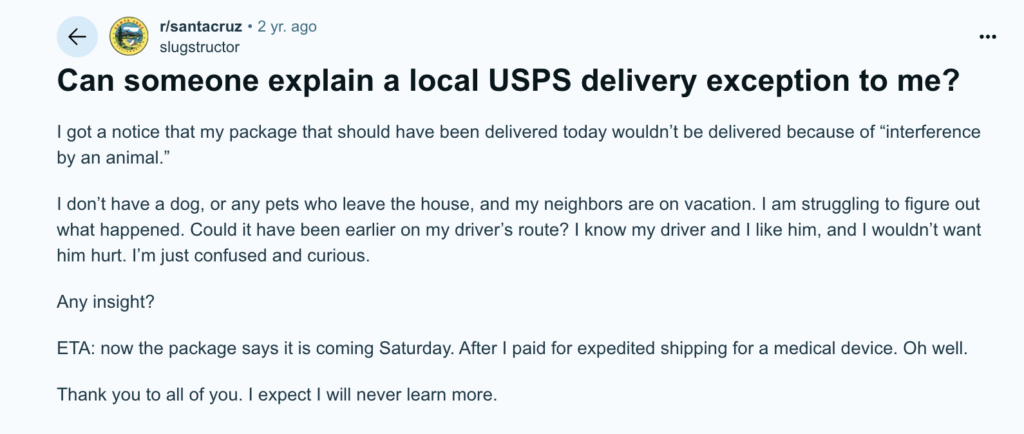
Read the real-life example above…
In the end, while the exact animal culprit remains a mystery, the delivery exception has been triggered by an unexpected encounter along the route. The package was rescheduled for Saturday, far later than the expedited promise, leaving our customer with amusement and mild frustration.
How It Could Have Been Solved?
Here’s where a bit of a modern solution could have helped smooth things over:
- Real-Time Tracking: With advanced delivery experience management software, the shipper and the recipient could get live updates, pinpointing exactly where the unexpected hiccup occurred. Knowing what happened in real-time can help calm nerves and speed up a resolution.
- Clearer Communication: If the update had included a specific note about animal interference on the route, it might have taken the sting out of the delay.
- Smart Route Planning: Carriers might analyze historical delivery data to spot routes that sometimes have these wild surprises. With this insight, they could adjust their routes or plan extra attempts during peak times, keeping delays to a minimum.
How can LateShipment.com help?
LateShipment.com’s Smart Incident Alerts keep you informed with pinpoint accuracy. You receive a real-time notification when an issue like delayed delivery, failed attempt, or lost package occurs. This lets you quickly investigate and resolve the problem before it spirals into customer frustration, ensuring that every hiccup is managed proactively.
How Can LateShipment.com Help?
Do you wish you could dodge those annoying delivery exceptions that ruin a great customer experience? While you can’t eliminate them, you can stay one step ahead with LateShipment.com. Our delivery experience management software is your secret weapon for fixing problem orders before they snowball into negative reviews.
You get smart alerts when a delay, lost package, or failed delivery attempt occurs, so you can nip issues in the bud. With automated notifications, you can keep your customers in the loop, and your support team can quickly resolve problems using our integrated helpdesk shipping widget.
This means fewer headaches, happier customers, and more repeat purchases, all while reducing customer service costs.
Interested in transforming your delivery experience? Get on a call with us to find out more!
Frequently Asked Questions About USPS Delivery Exceptions
Will my package still arrive on time after a delivery exception?
Often, yes. Not every exception results in a late delivery. Carriers frequently reroute packages to work around the issue and still hit the original delivery date. You will know more once you check the updated tracking status.
How long does a USPS delivery exception last?
It depends on the cause. Weather or holiday exceptions typically resolve within one to two days. Address issues can take longer if the carrier cannot verify where to send the package. Customs holds on international shipments can stretch for a week or more.
Can I get a refund for a USPS delivery exception?
It depends on the cause. If the exception was due to carrier error, you may be eligible for a refund under the service guarantee. If it was caused by weather, a natural disaster, or another force majeure event, USPS does not issue refunds. If the error was on your end (wrong address, missing documentation), you are unlikely to get compensation.
What should I do if USPS marks a package as undeliverable?
Contact USPS directly with the correct delivery information. If the package has already been returned to sender, you will need to re-ship it. If you have shipping insurance, file a claim for any associated costs.
Related Reading
Monthly Newsletter
Get practical solutions and insights to tackle real-world post-purchase challenges directly in your inbox