


Quick answer:
Odd-shaped and odd-sized items: from vases and bike frames to sculptures and car bumpers: require custom packaging solutions because standard boxes do not fit them well. This creates three problems for small e-commerce businesses: higher dimensional weight charges from carriers, increased damage risk from poorly fitted packaging, and the time cost of figuring out non-standard packaging from scratch. The solution is choosing the right material for the item’s shape (stretch wrap and foam for curved objects, custom-cut corrugated for irregular protrusions), building or sourcing correctly sized boxes, applying the 2026 DIM weight calculation to your specific package dimensions before shipping, and auditing invoices for incorrectly applied oversize surcharges. LateShipment.com’s OneAudit automates that last step, recovering overcharges and saving SMBs up to 20% on shipping spend.
Key Takeaways
- For small e-commerce businesses selling non-standard products: Odd-shaped items are disproportionately expensive to ship because carriers bill on dimensional weight, not actual weight. A light but bulky item can cost as much to ship as something four times heavier. Managing the box dimensions is as important as managing the packaging itself.
- Packaging depends on the item’s specific shape challenge: Curved objects (vases, helmets) need wrap-based packaging like stretch wrap and foam. Protruding or irregular objects (bike parts, sculptures) need custom corrugated with edge protection. Very large objects (furniture, tires) may ship better as freight than as parcel.
- 2026 DIM weight rules apply to odd-sized items: In 2026, FedEx and UPS expanded their oversize criteria to include cubic volume (length x width x height in inches). A package exceeding 10,368 cubic inches now triggers an Additional Handling surcharge; above 17,280 cubic inches triggers the Oversize or Large Package Surcharge of $200-$330+ per package. Odd-shaped items in large boxes are especially exposed to these charges.
- DIY custom boxes are a cost-effective SMB option: You do not need to buy custom-manufactured boxes for most odd-sized items. Two standard corrugated boxes can be combined: by removing the flaps of the second and sliding it over the first: to create a custom-height or custom-width container for irregular shapes.
- Overcharge recovery is available for incorrectly applied surcharges: Carriers sometimes apply oversize or additional handling surcharges to packages that don’t actually meet the threshold criteria. LateShipment.com’s OneAudit automatically flags and claims these billing errors on behalf of SMBs.
People judge a book by its cover, a movie by its trailer, and a parcel by its packaging.
When you ship a product across and the customer has a first look, the packaging that matters.
A neatly-packaged product delivered without any flaws speaks volumes about brand credibility more than a wonderful product that turns up at a customer’s doorstep haphazardly packed.
But packaging isn’t as easy as it sounds. It is an exhaustive task that requires considerable planning and work.
Packaging heavily depends upon the types of products that you sell.
T-shirts, books, pillow covers, etc. are fairly straight-forward and don’t entail much worry. But what about packaging odd-shaped objects? Well, that certainly requires some creativity.
Let’s explore how one can package odd-shaped and odd-sized products not just flawlessly and creatively but also efficiently.
What Are Odd-Shaped/Sized Objects?
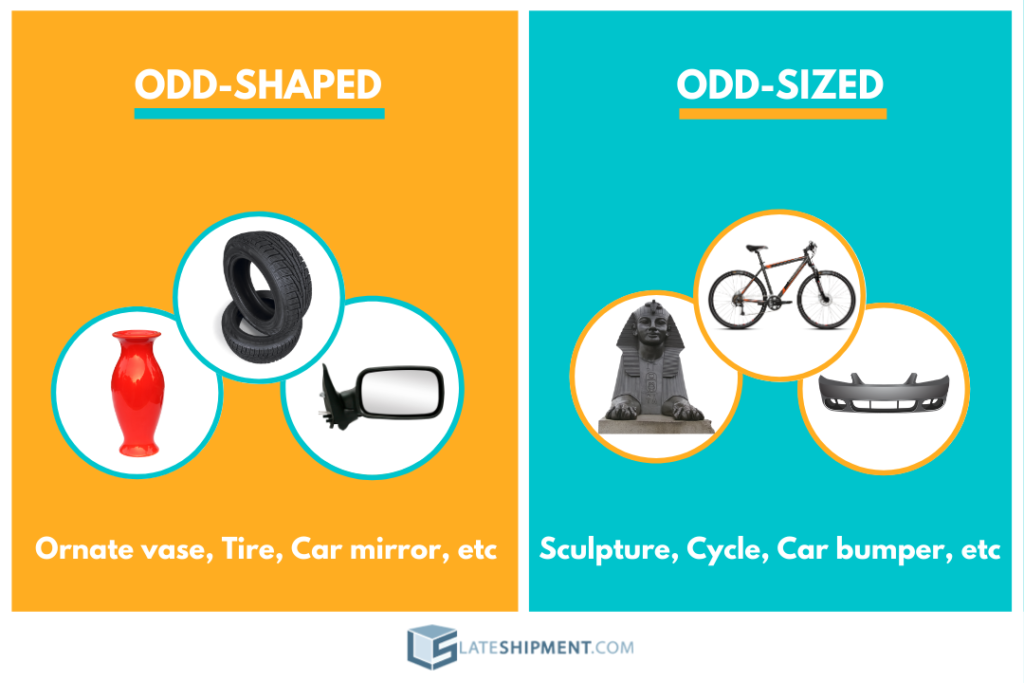
An odd-shaped object is anything that doesn’t fit into the mold of a standard square or rectangle. This can be anything from an ornate vase to a car mirror, a tire, a bicycle, or a sculpture.
An odd-sized object is anything that cannot be contained within a standard carton box due to its dimensions: even if its shape is relatively regular. A long curtain rod, a surfboard, or a rolled-up rug might have a fairly simple shape but still create packaging challenges because of their length or diameter.
The packaging challenge is different for each. An odd-shaped item might fit in a box but needs custom internal support. An odd-sized item might need a custom-built container or multiple boxes combined.
Why Is Packing Odd-Shaped Items More Difficult Than Standard Shipments?
Shipping odd-shaped or odd-sized objects creates four specific challenges that standard products don’t have:
- Oversize category risk: Packages with irregular shapes often end up in boxes that are larger than the item requires, which triggers dimensional weight (DIM weight) pricing and potentially oversize or additional handling surcharges. In 2026, both FedEx and UPS expanded their oversize criteria to include cubic volume, meaning more odd-sized packages now qualify for these fees.
- Higher shipping costs: Particularly for retailers dealing in odd or oversized products, shipping costs compound month on month. An item that weighs 3 lbs but ships in a 20x20x20 inch box is billed at its dimensional weight: potentially 10+ lbs depending on the carrier’s DIM factor: not its actual weight.
- Need for special packaging: Standard corrugated boxes and standard cushioning materials don’t work for most odd-shaped items. Stretch wrap, foam tubes, custom corrugated shapes, or custom crates are often necessary.
- Logistical complexity: Odd-sized items are harder to palletize, may require a freight carrier instead of a parcel carrier, and are more likely to experience mishandling at sorting facilities where machinery is optimized for standard box shapes.
Related: Oversize Surcharge in 2026: FedEx and UPS Thresholds Explained -> lateshipment.com/blog/oversize-surcharge/
How to Pack Odd-Shaped/Sized Items
Packing odd-shaped objects is not rocket science.
But how exactly do you pack them in the first place?
The secret ingredient is picking the right packaging material that will ensure easy wrapping as well as utmost safety in transit.
Packaging odd-shaped objects has been made much easier with the variety of materials available today.
What Packaging Materials Work Best for Odd-Shaped Items?
The right packaging material for an odd-shaped item depends on the item’s specific shape challenge. Here is a guide by item category:
| Item Category | Examples | Recommended Materials | Why |
|---|---|---|---|
|
Curved or rounded items |
Vases, helmets, sculptures, round containers, bowls |
Stretch wrap as a first layer, foam sheets for padding, corrugated box with fill |
Stretch wrap conforms to curves without adding bulk. Foam sheets protect surfaces. Fill eliminates movement in the box. |
|
Long or cylindrical items |
Golf clubs, fishing rods, curtain rods, tubes, rolled rugs, baseball bats |
Corrugated tubes or triangular mailers, reinforced with tape, or cardboard wrapped tightly around the item |
Tubes protect long items from bending forces. Triangular mailers are more stable than round tubes during transit. |
|
Items with protruding parts |
Bicycle parts, furniture with legs, sculptures with thin elements, figurines |
Corrugated cardboard cut to shape and wrapped around protrusions, foam padding on each protrusion, placed in a custom-size box |
Each protrusion needs individual padding. Box walls must not contact any protrusion directly without cushioning. |
|
Tires and rings |
Tires, wheels, wreath frames |
Pressure-sensitive tape wrapped around the full circumference, shrink wrap for surface protection, label applied with transparent tape |
Tires roll in transit. Full-circumference taping stabilizes the shape. Shrink wrap protects the surface from abrasion. |
|
Flat but irregular shapes |
Mirrors, art canvases, cutting boards with handles |
Foam corner protectors on all corners and edges, bubble wrap on the face, flat corrugated boards front and back, then placed in a fitted box |
Corners are the most vulnerable point for flat items. Two layers of corrugated prevent flex forces from cracking the surface. |
|
Heavy irregular items |
Engine parts, gym equipment, stone items, machinery components |
Dense foam on all sides, heavy corrugated (double or triple wall), strapping tape on the outside of the box |
Heavy items generate more force on impact. Triple-wall corrugated and dense foam absorb these forces more effectively than standard boxes. |
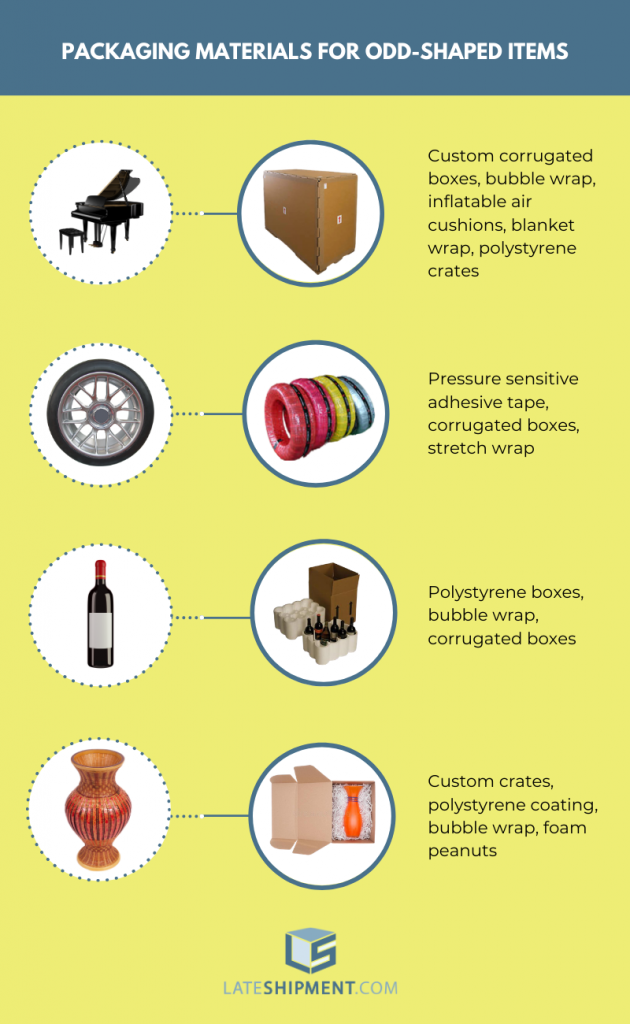
Most odd-shaped or sized objects can fit into a corrugated box with the right packing materials. However, in some cases the odd-shaped object is larger than any single standard box and may require a custom container. In that case, building a custom-sized box from two standard boxes is a cost-effective SMB solution.
How to Make Your Own Custom Boxes for Odd-Shaped Items
If you prefer to make your own boxes for packaging, you need to keep in mind that it takes time. But it is often more cost-effective than purchasing custom-manufactured boxes for one-off or low-volume shipments.
How do you build a custom-sized box from two standard boxes?
- Once you have wrapped and secured your odd-shaped object, place it in a sturdy corrugated box.
- Take another similar box and place it below or next to the first box, based on your object’s dimensions.
- Remove the flaps of the second box to create an extra-tall or extra-wide packaging container.
- Slide the second box over the first to extend the total container size.
- Properly seal the joined boxes together with heavy-duty tape along all seams.
This method works well for items that are too tall or too wide for a single box but not so large that they require freight shipping.
What Are the Best Packaging Tips for Odd-Shaped Items?
Here are the seven packing tips most useful for non-standard shapes:
- Use corrugated tubes for rolled goods. A bag or plastic covering is usually not enough protection for items like fishing rods, curtain rods, or artwork rolls. Corrugated tubes provide structural rigidity against bending and impact.
- Tape tires around the full circumference. If you’re packing a tire, use pressure-sensitive tape to wrap around the entire width of the tire in a full circle, not just over the top and bottom. This stabilizes the shape during transit.
- Eliminate sharp edges. Do not leave any sharp edges, corners, or protrusions exposed. Paste pieces of cardboard or use small polystyrene covers to blunt sharp edges. This protects both the item and other packages that may be in contact with yours during sorting.
- Protect the item at every layer. Add layers of bubble wrap, crumpled paper, or foam sheets based on the value of the package. The item should sit securely within the box with no movement. Also add a layer of protection on top of the item before closing the lid.
- Test box strength before sealing. Always test the strength of the box before sealing, especially if you’re packing heavy items like working models, gym equipment, or machinery parts. Press the sides: if they flex significantly, move to a double-wall or triple-wall box.
- Label and direct handlers. Add ‘Fragile’ and directional labels (This Side Up, Handle with Care) as applicable. For items that must remain upright, label all four vertical faces so handlers see the instruction regardless of which side they pick up.
- Secure the address label with transparent tape. If you cannot find a flat surface large enough to stick the address on, use transparent tape over the entire address label to make sure it does not fall off, get wet, or become unreadable during transit.
How Do You Ship Odd-Sized Items Cost-Effectively?
Considering how most odd-shaped items end up in boxes that are too large, it is no wonder dimensional (DIM) weight pricing can hit the roof. There are times when you realize the cost of shipping and the product cost are almost at the same level.
Here is how to manage shipping costs for odd-sized items:
How does dimensional weight pricing affect odd-sized shipments?
Shipping carriers have moved to dimensional weight pricing, where the cost of a shipment depends on the larger of the actual weight or the calculated dimensional weight. The DIM weight formula is: (length x width x height in inches) / DIM factor. For FedEx and UPS, the standard DIM factor is 139 for domestic shipments.
For most odd-sized packages, the DIM weight is considerably more than the actual weight. A sports goods business shipping custom-made helmets or baseball bats pays for boxes that are not a snug fit. The odd shape of a golf club or a bat means the box will have to be stuffed with additional packing materials, which adds to both the dimensional weight and the cost.
In 2026, both carriers also introduced new cubic volume thresholds: FedEx and UPS now apply an Additional Handling Surcharge to packages with a cubic volume above 10,368 cubic inches, and an Oversize or Large Package Surcharge above 17,280 cubic inches. For odd-sized items in large boxes, this means surcharges of $200-$330+ per package are now triggered by more packages than before. For a small business, a single misclassified package can represent a significant unexpected cost.
How do you reduce DIM weight on odd-shaped shipments?
The most effective approach is to negotiate with your shipping carrier and work to reduce the DIM weight denominator at which you are billed. For high-volume shippers, this is a legitimate contract negotiation point that can reduce shipping costs meaningfully.
For lower-volume SMBs, the practical approach is: build the tightest possible box around the item rather than using the closest standard box size, use form-fitting packaging materials rather than loose fill to minimize box size, and consider disassembling the item if it is made of separable components. Shipping a bicycle as four boxes (frame, wheels, handlebars, seat post) instead of one assembled bicycle box can dramatically reduce dimensional weight and eliminate oversize surcharges.
All things considered, there are still chances you may overpay your shipping carrier on odd-sized shipments. To recover those overcharges, you can use LateShipment.com’s OneAudit, which audits your monthly shipping invoices and claims refunds for overcharges on your behalf: including incorrectly applied oversize and additional handling surcharges that do not match your actual package dimensions.

How Do You Make Packaging for Odd-Shaped Items Reflect Your Brand?
Packaging in today’s retail space is about much more than just functionality. Whatever your item’s shape or size may be, customizing it to reflect your brand image increases brand recall and gives your store an edge over competitors.
A personalized tag or unique wrapping paper can make a real difference, especially for handmade or artisan goods where the unboxing experience is part of the product’s value proposition.
With sustainable practices like green packaging becoming increasingly standard, opting for biodegradable materials or those that can be reused and recycled gives your brand a credible sustainability story. By using eco-conscious packaging, you reduce your carbon footprint and make a positive impression on customers who care about environmental impact.
For packaging materials, use locally sourced items where possible. Reuse boxes as much as you can, and build custom-sized boxes from larger used ones. This reduces costs and keeps unused packaging out of landfills.
On the off chance that a specific item is exceptionally hard to package well, FedEx, UPS, and other carriers offer professional packaging services. Both FedEx and UPS back their in-store packing services with a safety guarantee, so your product is protected. This is a particularly sensible option for high-value one-off shipments like electronics or fragile art.
How LateShipment.com Helps SMBs Ship Odd-Sized Items More Cost-Effectively
LateShipment.com helps small e-commerce businesses reduce shipping costs on odd-sized items in two specific ways:
Invoice auditing for overcharges: Carriers sometimes apply oversize surcharges, additional handling fees, or dimensional weight charges to packages that don’t actually meet the threshold criteria. LateShipment.com’s OneAudit automatically reviews your monthly shipping invoices for 50+ service failure and billing error categories, flags incorrect charges, and files refund claims on your behalf. The refunded amount is deposited directly into your account. This can save SMBs up to 20% on overall shipping spend, which is particularly meaningful for businesses shipping odd-sized items that frequently brush against surcharge thresholds.
Delivery experience management: OneTrack gives you real-time visibility across all your carriers on a single dashboard. For SMBs shipping high-value or fragile odd-shaped items, knowing exactly where each shipment is and getting proactive alerts about potential delays allows you to communicate with customers before they reach out with ‘where is my order?’ queries.
Shipping protection: LateShipment.com’s OneProtect provides comprehensive risk coverage for lost or damaged shipments, with a centralized claims process that takes seconds rather than the hours that manual carrier claim filing typically requires.
Book a product tour: lateshipment.com/product-tour/audit-refunds/
FAQs: Shipping Odd-Shaped and Odd-Sized Items
What counts as an odd-shaped or odd-sized item for shipping?
An odd-shaped item is anything that doesn’t fit into a standard square or rectangular box without awkward gaps or protrusions: vases, sculptures, helmets, bicycle parts, car mirrors, and curved art pieces are common examples. An odd-sized item is anything that exceeds standard box dimensions due to its length, height, or combined dimensions, even if it has a relatively simple shape: golf clubs, surfboards, rolled rugs, curtain rods, and furniture are typical examples. Both create packaging challenges and often trigger dimensional weight or oversize surcharges from carriers.
How do you calculate dimensional weight for an odd-shaped item?
Dimensional weight is calculated as (length x width x height in inches) divided by the carrier’s DIM factor. For FedEx and UPS domestic shipments, the standard DIM factor is 139. The carrier charges whichever is greater: the actual weight or the dimensional weight. For a package measuring 20 x 20 x 20 inches, the DIM weight is 8,000 / 139 = approximately 57.5 lbs. If the actual item weighs 5 lbs, you are billed at 57.5 lbs. Managing box dimensions to reduce DIM weight is therefore as important as the item’s actual weight when calculating shipping costs for odd-sized products.
What packaging materials work best for shipping odd-shaped items?
It depends on the shape challenge. For curved or rounded items (vases, helmets), stretch wrap as a first layer conforms to the shape, followed by foam sheets and a corrugated box with loose fill. For long cylindrical items (rods, clubs), corrugated tubes or triangular mailers provide structural rigidity against bending. For items with protruding parts (bike frames, sculptures), wrap each protrusion individually in foam before placing in a custom-sized box. For tires, wrap pressure-sensitive tape around the full circumference. The universal principle is that no part of the item should contact the box wall directly without cushioning between them.
How do you build a custom box for an odd-shaped item?
The simplest approach for most SMBs is the two-box method: place the wrapped item in a corrugated box, take a second similar-sized box and remove its flaps, then slide the second box over the first to extend the container’s height or width. Seal all seams with heavy-duty tape. This creates a custom-depth or custom-width container without purchasing manufactured custom boxes. For items that protrude significantly in one direction, corrugated sheets can be cut and folded to create custom end caps or side extensions.
How do carriers charge for odd-sized items in 2026?
In 2026, both FedEx and UPS apply a two-tier surcharge structure based on cubic volume (length x width x height in inches). An Additional Handling Surcharge applies above 10,368 cubic inches, running $20-$30+ per package. A Large Package or Oversize Charge applies above 17,280 cubic inches or 110 lbs actual weight, running $200-$330+ per package depending on zone. These thresholds are new for 2026 and capture more odd-sized packages than the previous length-only criteria. For a 24x24x24-inch box, the cubic volume is 13,824 cubic inches: which triggers the Additional Handling Surcharge even if the item inside weighs only a few pounds.
Is freight shipping better than parcel for odd-sized items?
For items that consistently trigger the Large Package or Oversize Surcharge, LTL (less-than-truckload) freight often makes better economic sense than parcel shipping. At $200-$330+ per package in surcharges plus base rate, parcel shipping for truly oversized items can easily exceed freight rates on a per-unit basis. The trade-off is transit time (freight is typically 4-7 days vs 1-5 for parcel) and handling complexity. For SMBs shipping furniture, large sporting goods, garden equipment, or automotive parts regularly, modelling both parcel and LTL costs using actual shipment data is worth doing before committing to a carrier strategy.
Can I get a refund if my odd-sized item is charged an oversize fee incorrectly?
Yes. Carriers sometimes apply oversize or additional handling surcharges to packages that don’t actually meet the dimensional threshold criteria, either because the package was measured inaccurately at the facility or because the billing system misclassified the shipment. These are recoverable billing errors. LateShipment.com’s OneAudit automatically reviews every invoice line against your shipment data and carrier criteria, flags incorrectly applied oversize and surcharge fees, and files refund claims before the claim window closes. For SMBs shipping odd-sized items regularly, this audit pays for itself quickly.
How can small businesses reduce shipping costs on non-standard shaped items?
Four approaches work consistently: first, right-size packaging by building custom boxes instead of using oversized standard boxes, which directly reduces DIM weight and can eliminate cubic volume surcharge triggers. Second, disassemble products where possible so each component ships in a correctly sized box rather than one oversized container. Third, negotiate your DIM factor with your carrier if you are a volume shipper: the standard 139 DIM factor is negotiable for accounts with consistent shipping volume. Fourth, audit carrier invoices through LateShipment.com’s OneAudit to recover incorrectly applied surcharges, which is particularly valuable for businesses whose shipment profiles frequently brush against dimensional thresholds.
Monthly Newsletter
Get practical solutions and insights to tackle real-world post-purchase challenges directly in your inbox