


Quick Answer
Invoice audit services verify carrier charges against contracted rates, service-level agreements, and billing rules to identify overcharges, billing errors, and refund-eligible service failures. For ecommerce and enterprise shippers, the relevant audit surfaces are: late delivery refunds, incorrect surcharges, DIM weight errors, duplicate charges, and lost and damaged shipment claims. Automated invoice audit services file refund claims automatically within carrier claim windows — most commonly a 15-day window for FedEx and UPS — and escalate denied claims through dispute resolution. Brands recover between 6% and 20% of shipping spend through consistent automated audit.
Key Takeaways
- Invoice audit services are strongest when they combine shipment events, carrier invoices, service commitments, and claim rules.
- Common recoveries include late delivery credits, duplicate charges, residential/commercial mismatches, dimensional weight errors, and accessorial overbilling.
- Manual auditing misses refunds because teams cannot review every shipment before claim deadlines.
- OneAudit audits carrier invoices, files eligible claims, and turns parcel data into shipping intelligence.
- Add carrier-specific sections to match enterprise shipper search intent.
Shipping remains one of the top three operating costs for e-commerce brands, accounting for 10 to 15% of total expenditure. What most ops and finance teams don’t account for is that a predictable share of that spend is recoverable. According to LateShipment.com research, the average brand shipping at meaningful volume overpays carriers by 6 to 20% per billing cycle through a combination of late delivery charges billed in full, incorrect surcharges, DIM weight overstatements, and duplicate billing. These are not exceptional errors. They are systematic, produced by the complexity of carrier billing at scale.
Invoice audit services exist to catch and recover these charges. The difference between a manual audit program and an automated one is not just efficiency — it is coverage. Manual audits catch the visible errors. Automated audit software catches every eligible shipment, within every claim window, across every carrier.
What Are Invoice Audit Services?
Invoice audit services are the process of verifying invoices from carriers or vendors against contracted rates, service-level agreements, and billing rules to identify discrepancies, recover overcharges, and prevent recurring errors.
In the context of parcel and freight shipping, invoice audit services cover three distinct recovery surfaces:
- Service failure refunds: Carrier service failures — late deliveries, missed pickups, and failed delivery attempts that are still billed at full rate despite a contractual SLA guarantee.
- Billing error recovery: Billing discrepancies — surcharges applied incorrectly, DIM weight overstated, rates applied from the wrong contract tier, duplicate invoice lines, and address correction fees applied without cause.
- Loss and damage claims: Lost and damaged shipment claims — shipments that were never delivered or arrived in damaged condition, for which the carrier owes a claim settlement.
Each of these surfaces has its own claim process, documentation requirements, and filing deadlines. Invoice audit services, whether managed manually or through software, systematize these processes so that eligible claims are not missed.
Why Invoice Audit Still Matters Today
Shipping remains one of the top three operating costs for e-commerce businesses, often accounting for 10–15% of total expenses. With FedEx and UPS announcing annual rate hikes averaging 5.9–6.5% and surcharges evolving constantly, the impact on margins is sharper than ever. For retailers navigating tariffs, peak-season surcharges, and international complexity in 2025, a shipping invoice audit is no longer optional it’s the only way to ensure you’re not leaving money on the table.
Yet, most businesses still rely on manual processes or don’t audit at all, losing out on 6–20% in recoverable shipping costs.
Why Shipping Invoices Are a Gold Mine of Errors
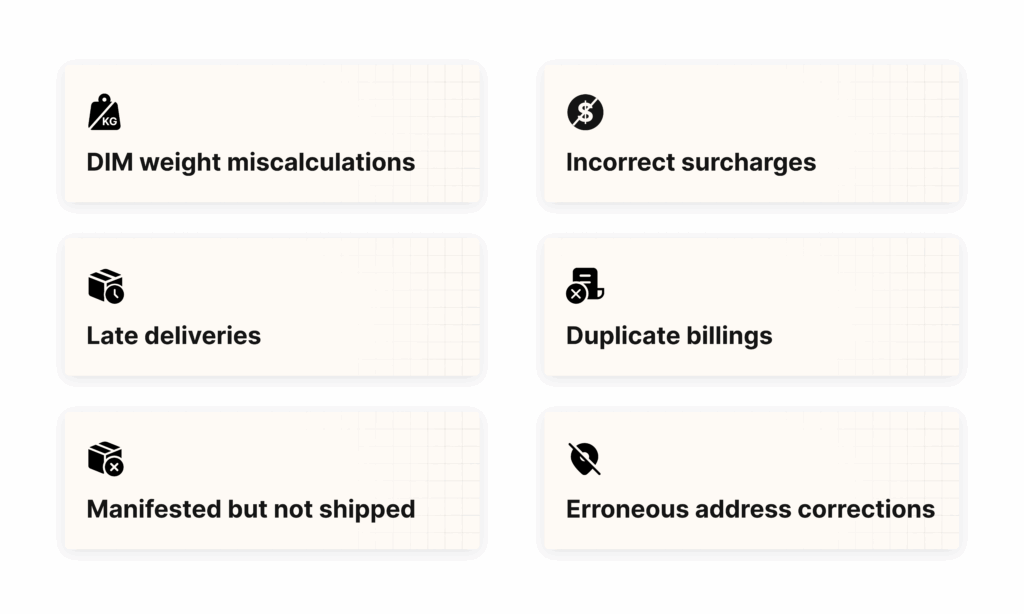
Carriers process millions of packages daily. Mistakes whether small or systemic are inevitable. Without auditing, you’re paying for errors that should have been credited back.
The most common billing errors every retailer should watch for include:
- DIM weight miscalculations — packages billed at inflated dimensional weights instead of actual weight.
- Incorrect surcharges — residential, fuel, address correction, or oversized fees wrongly applied.
- Late deliveries — carriers missing guaranteed service times but still charging in full.
- Duplicate billings — the same package invoiced more than once.
- Manifested but not shipped — labels billed despite shipments never moving.
- Erroneous address corrections — fees charged when the original address was valid.
Each of these errors may look insignificant on its own, but across thousands of shipments they accumulate into hundreds of thousands of dollars lost annually.
The Carrier Agreement Fine Print
Auditing only delivers value if it aligns with your carrier contracts. FedEx, UPS, DHL, and regional carriers include service guarantees and refund policies in their agreements. Understanding these clauses is crucial.
Service guarantees, for instance, often promise overnight deliveries by 10:30 a.m. and any delay is grounds for a refund. But many retailers unknowingly sign away such guarantees when they agree to new terms.
Accessorial fees like fuel, residential, or oversized surcharges also vary between carriers and are frequently misapplied. These fine-print details shape your recovery potential.
The Pitfalls of Manual Audits
On paper, manual auditing sounds straightforward: match invoices with shipment data, flag inconsistencies, and file claims. In practice, it’s overwhelming and highly inefficient.
Invoices often arrive in different formats, making reconciliation error-prone. The sheer data volume is daunting a mid-size retailer shipping 10,000 parcels a month faces more than 120,000 individual data points to audit. Add to that the frustration of filing disputes manually, which often results in delays and outright denials from carriers, and it becomes clear why most businesses capture less than 20% of recoverable credits when relying on manual processes.
International shipments compound the problem. Duties, taxes, brokerage fees, and fluctuating exchange rates all introduce additional opportunities for error, which manual teams struggle to catch.
Manual vs Automated Invoice Audit: What the Comparison Actually Looks Like
Most brands that audit shipping invoices start with a manual process: someone on the ops or finance team reviews invoices against carrier contracts, flags discrepancies, and submits claims through the carrier portal. At low volume, this works. At scale, it does not.
| Dimension | Manual Invoice Audit | Automated Invoice Audit (e.g., OneAudit) |
|---|---|---|
| Coverage | Dependent on analyst bandwidth. High-volume shipments often reviewed by sampling, not line by line. | Every invoice line audited against 160+ checkpoints automatically on receipt. |
| Claim window compliance | Claims commonly missed when the 15-day FedEx/UPS window falls during high-volume periods or staff absence. | Claims filed automatically on invoice receipt, before the window closes. |
| Error categories caught | Typically catches late deliveries and major surcharge errors. DIM weight errors, duplicate charges, and minor billing discrepancies are often missed. | Catches 50+ error categories including DIM discrepancies, duplicate lines, accessorial errors, and contract-rate mismatches. |
| Denied claim escalation | Requires manual follow-up. Denied claims are often abandoned rather than disputed. | Denied claims are flagged for human specialist escalation through the formal dispute process. |
| Data output for negotiations | Limited. Manual audits rarely produce structured carrier performance datasets. | Structured dataset covering carrier on-time rates, surcharge patterns, refund success rates — usable for contract renegotiations. |
| Cost | Internal labor cost plus opportunity cost of uncaught claims. | Success-fee model typical. No recovery, no fee. OneAudit charges 35% of refunds claimed. |
Why 2026 Makes Audits Even More Critical
The current year brings unique headwinds that make invoice audits indispensable. Tariffs and geopolitical shifts have created unpredictable surcharge patterns. Peak-season shipping strains guarantee reliability, generating even more late deliveries and refund opportunities. Meanwhile, cross-border sales are growing, bringing with them higher error rates on customs and duties.
On top of that, carriers are experimenting with AI-driven dynamic pricing models, introducing constantly shifting surcharges. A manual audit team simply cannot keep pace. Automated audits are no longer a nice-to-have they’re the only way to keep your shipping spend in check.
How to Implement an Automated Audit
Turning invoice audits into a consistent profit lever requires a structured approach. Retailers who succeed tend to follow a clear path:
- Baseline your costs by reviewing 3–6 months of historical invoices to spot leakage trends.
- Ensure seamless data access by integrating carriers, ERPs, and shipping platforms.
- Audit daily, not monthly since refund eligibility is time-sensitive.
- Track refund performance to monitor weekly and monthly recovery rates.
- Go beyond refunds by using audit insights to renegotiate carrier contracts and refine your shipping mix.
What to Look for in an Invoice Audit Service: Evaluation Criteria for Enterprise Shippers
The market for invoice audit services spans manual audit firms, hybrid managed-service models, and fully automated software platforms. For enterprise and mid-market ecommerce shippers, the evaluation criteria that matter most are:
- Coverage model: 100% line-item audit vs sampling: An audit that reviews 100% of invoice lines is structurally different from one that works by sampling or periodic batch review. Sampling misses claims, particularly in high-volume periods.
- Claim window compliance process: FedEx and UPS have 15-day windows for most service failures. A provider whose process runs on a weekly or monthly cadence cannot consistently file within this window. Ask specifically how the provider handles the claim window across different carriers.
- Denied claim escalation: First-time denials are not final. Providers who stop at the initial denial leave money on the table. Human specialist escalation through the carrier dispute process is what overturns denied claims that automated systems cannot resolve.
- Coverage across all audit surfaces: The audit covers service failures, billing errors, and loss/damage claims. A provider that only covers one category misses the other two recovery surfaces. Confirm coverage across all three.
- Structured data output: The data produced by auditing — carrier on-time rates, surcharge trends, DIM error patterns — should be accessible in a usable format. Ask whether the provider exports to BI tools or produces structured carrier scorecards.
- Pricing model: Most invoice audit services operate on a success-fee model. Verify the commission rate and confirm whether it applies to all recovered amounts or only to specific claim types. OneAudit charges 35% of refunds claimed.
Metrics That Ops and Finance Teams Should Track from Invoice Audit
An invoice audit program is only as useful as the data it surfaces. These are the metrics that tell you whether your audit is working and where to focus next:
| Metric | What It Tells You |
|---|---|
| Refund recovery rate (%) | The share of total shipping spend recovered through audit. Benchmark: 6–20% for brands shipping at meaningful volume. Below 3% suggests gaps in coverage or claim window compliance. |
| Claim approval rate (%) | The percentage of filed claims that carriers approve. Low approval rates by carrier reveal which carriers dispute more and may indicate a documentation quality issue. |
| Claim denial recovery rate (%) | The share of initially denied claims overturned through escalation. A strong audit provider overturns a material share of first-time denials. Zero recovery on denied claims suggests no escalation process. |
| Error category breakdown | Distribution of refunds by error type: late deliveries, surcharge errors, DIM overcharges, duplicate charges, L&D claims. Surcharge growth quarter-over-quarter is a contract negotiation signal. |
| Carrier on-time performance rate (%) | Claims data reveals actual on-time rates, not the carrier’s reported rates. Significant gaps between reported and actual performance are the basis for SLA renegotiation. |
| Cost per recovered dollar | Total audit program cost divided by total refunds recovered. For success-fee models, this is the commission rate. Benchmark against the internal labor cost of manual audit for the same coverage. |
Benchmarking these metrics quarterly against your prior periods surfaces systemic issues. A surcharge category that is growing faster than shipment volume, for example, signals either a carrier billing change or a shift in your shipment profile that may be actionable at the contract level.
Why LateShipment.com Is the Only Platform You Need

LateShipment.com’s Automated Shipping Invoice Audit detects delivery exceptions before customers complain, automates claims for lost or damaged packages, and integrates audit insights into tracking and returns modules for complete visibility. It works globally across FedEx, UPS, DHL, USPS, and over 1,200 carriers. And because it is seamlessly connected with other solutions like branded tracking and intelligent returns, it creates a truly unified post-purchase ecosystem.
Customers recover up to 20% of shipping costs they were unknowingly paying carriers all with zero manual effort.
Lost and Damaged Claims: The Second Audit Surface Most Brands Underwork
Late delivery refunds get most of the attention in invoice audit conversations because they are the most visible service failure. Lost and damaged shipment claims are the second audit surface — and they are typically underworked because they require a different process from service failure refunds.
A lost shipment claim requires: documentation that the shipment was tendered to the carrier, confirmation that the carrier failed to deliver, and proof of the shipment’s declared value. A damaged shipment claim requires: evidence of the damage (photos, condition reports), the declared value, and in some cases the carrier’s proof-of-delivery record showing the scan location.
Manual processes struggle with these claims because assembling the documentation takes time, and the claim window closes before all materials are gathered. OneAudit handles lost and damaged claims within the same automated workflow as service failure refunds: eligible shipments are identified, documentation is captured, claims are filed, and denied claims are escalated.

Audit Data as a Carrier Negotiation Asset
Most ops teams treat parcel audit as a refund recovery mechanism. The finance teams that get the most value from it treat the audit data as a carrier performance dataset.
Every audited invoice line produces structured data: carrier, service level, zone, billed weight, actual weight, on-time status, error type, and resolution. Over a billing period, that data reveals patterns that a single invoice never shows:
- Which carriers have the highest late delivery rates on which lanes
- Which surcharge categories are growing fastest as a share of total spend
- Where DIM weight overcharges are concentrated by package type or warehouse
- How refund recovery rates compare across carriers — which carriers deny more claims and which settle quickly
This data is the input to carrier contract renegotiations. A shipper who arrives at a carrier negotiation with documented on-time performance rates, surcharge trend data, and claim denial rates has leverage that a shipper relying on the carrier’s own reporting does not.
OneAudit surfaces this data in carrier scorecards and fulfillment intelligence reports. The 160-checkpoint audit generates a structured dataset that ops and finance teams can use both for refund recovery and for the contract negotiation conversations that follow.
Stop Leaving Money on the Table
In today’s margin-tight environment, every overcharge or denied refund chips away at profitability. Manual audits cannot keep pace with the scale, complexity, and international reach of modern shipping operations.
With automated audits, you not only recover hidden dollars but also gain the operational clarity to manage your logistics spend with confidence.

FAQs on Automated Invoice Audit
What does a shipping invoice audit service do?
It reviews carrier invoices and shipment data to identify billing errors, overcharges, service failures, and refund opportunities.
How is automated invoice auditing different from manual auditing?
Manual auditing samples invoices. Automated auditing checks every shipment and invoice line against carrier rules and claim windows.
What is the best automated shipping audit software for enterprise shippers?
Enterprise shippers should look for solutions like LateShipment.com, which has multi-carrier coverage, automated claim filing, invoice line-item auditing, refund reporting, and carrier performance analytics.
How does LateShipment.com's OneAudit automate carrier invoice recovery?
OneAudit connects shipment and invoice data, detects eligible service failures and billing errors, files claims, and reports recovered savings and carrier trends.
Monthly Newsletter
Get practical solutions and insights to tackle real-world post-purchase challenges directly in your inbox