


Key takeaways
- What “out for delivery” actually means: In the 4-8 hours between when a package leaves the local hub and arrives at your customer’s door, you’ll either cement customer loyalty or lose them forever.
- Why this stage matters most: Customer anxiety peaks, support inquiries spike 3-5x, and 85% of shoppers won’t return after a bad delivery experience
- The true cost of poor delivery management: Based on our research, failed deliveries cost $15-25 per incident, WISMO tickets add up to $1,200+/month in support costs, and each negative experience loses you $168 in customer lifetime value
- 5 critical actions merchants must take: From proactive customer communication and delivery monitoring to exception handling and adding FAQs
- The technology advantage: Why automation and real-time visibility separate merchants who struggle with delivery issues from those who turn this stage into a competitive advantage
- Real ROI from better delivery management: According to LateShipment.com’s data, offering a superior delivery experience can result in a 60% drop in support tickets, a 40% decrease in delivery-related returns, a 23% increase in repeat purchases, and $4-7 saved per shipment
Stop treating “out for delivery” as a passive tracking status. This is an active stage requiring strategic management. Merchants who master proactive communication, exception monitoring, and carrier accountability see dramatically lower costs and higher customer satisfaction.
Ready to transform your final mile from a cost center into a profit center? Let’s dive in.
The Out for Delivery stage could be your hidden profit center (or leak)
The “out for delivery” stage isn’t just another tracking status or stage in the delivery lifecycle, it’s the moment when your brand promise either lands at your customer’s doorstep or falls apart. This is where customer loyalty solidifies or evaporates.
From your customer’s perspective, this is when excitement peaks and anxiety sets in. The package has successfully evaded almost 80% of all delivery issues, but that final mile holds all the risk—package theft, delivery to the wrong address, damage, or simply never arriving.
Here’s what happens in the 4-8 hours between “out for delivery” and “delivered”:
- Your customer support team fields 3-5x more inquiries than any other delivery stage
- 40% of customers refresh tracking pages multiple times per hour
- Failed deliveries cost you $15-25 per incident in support time, reshipment fees, and lost sales
- 85% of shoppers won’t purchase from you again after a negative delivery experience
There’s also the financial impact of things. Say you’re a store shipping 1,000 packages per month:
- 150+ WISMO tickets @ $8/ticket = $1,200/month in support costs
- Failed deliveries: 3-5% rate × $20 per failure = $600-1,000/month in reshipment costs
- Customer churn: One bad delivery experience = $168 average customer lifetime value lost
From your perspective, this is your last chance to:
- Prevent support tickets through proactive communication
- Catch delivery exceptions before customers complain
And more.
In this guide, we’ll show you how to properly handle the “out for delivery” stage—turning it from a cost center into a competitive advantage.
What does Out for Delivery mean?
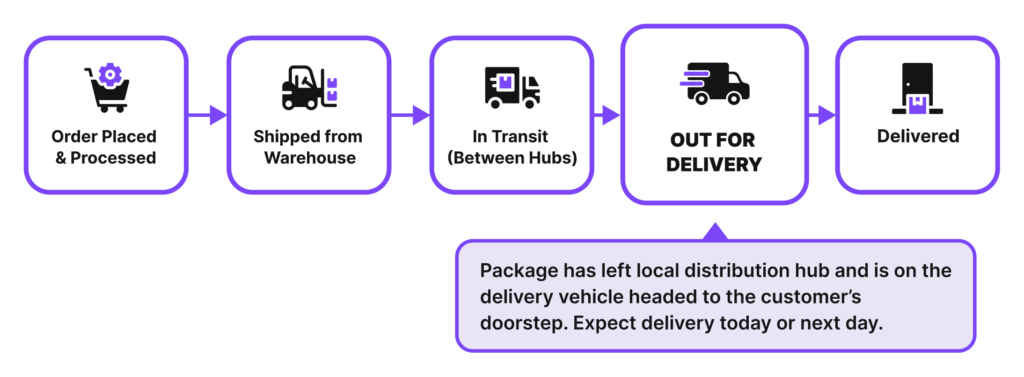
“Out for delivery” means your customer’s package has left the local distribution hub and is loaded on a delivery vehicle heading to their address. This is the final stage of the shipping journey before the package reaches your customer’s doorstep.
Packages that are marked “out for delivery”, will reach their destination on the same day or the next day, given the distance and situation between the carrier’s transportation hub or fulfillment center and the customer’s doorstep.
Where it sits in the delivery journey:
- Order Placed – Order confirmed and processing begins
- Shipped – Carrier picks up the package from your warehouse/fulfillment center
- In Transit – Package moves between carrier hubs and sorting facilities
- Arrived at Local Facility – Package reaches distribution center nearest to customer
- Out for Delivery – You are here – Package loaded on truck, en route to customer
- Delivered – Package successfully reaches the customer’s delivery address
Why this stage matters most to merchants
Unlike earlier stages where packages move through predictable carrier networks, “out for delivery” is where variables multiply:
- Human factors (delivery driver decisions, customer availability)
- Micro-local conditions (traffic, weather, access issues)
- Address accuracy becomes critical
- Customer anxiety peaks (driving support inquiries)
- Package theft risk is highest
- Last opportunity to prevent delivery failures
The difference between a package sitting in a warehouse 500 miles away and a package “out for delivery” is urgency. Your customers refresh tracking pages, rearrange schedules to be home, and contact your support team if anything seems off.
The good news: This is also your highest-leverage stage for creating exceptional customer experiences. Packages marked “out for delivery” have overcome the majority of shipping risks—they’re in the final stretch. Smart communication and exception management here pay outsized dividends in customer satisfaction and loyalty.
What e-commerce merchants should do when orders are Out for Delivery
Stop thinking of “out for delivery” as a passive tracking status. This is an active stage requiring strategic management. Here’s your action plan:
1. Proactive Customer Communication
This is fairly straightforward. When the order status shifts to out for delivery, send a proactive shipping notification across email, SMS, WhatsApp, etc, highlighting:
- A tracking page link with the expected delivery timeframe – To let customers know that they can expect the order to be delivered soon
- What’s being delivered (products listed) – To remind customers of their carts once more and allow customers to initiate quicker/ easier returns by simply refusing to collect their orders
- Delivery tips (signature requirements) – To let the customers have an adult in the delivery location to collect the package in case of high-value items or dangerous goods,
- Support contact options, etc – To make last-minute urgent changes with the order getting delivered, like suggesting alternative delivery locations.
2. Set Up Delivery Monitoring & Alerts
Let’s say things don’t go smoothly and trust us, such things are bound to happen more than you expect them to; you don’t want your customers to get frustrated over them. Because all your efforts to provide them with a great CX can take a hit if you don’t take action to resolve issues at this stage. The first step of your action is pretty simple: set automated alerts for your teams to catch issues before customers notice.
- If the package is stuck in “out for delivery” for 12+ hours, investigate with the carrier immediately and share the update with customers on what went wrong and how it can be fixed
- If multiple delivery attempts failed, contact with the customer to arrange alternative delivery
- If the carrier has flagged a delivery exception, immediately communicate with the customer, starting with the updated delivery date.
P.S. You don’t have to sit down and do these things manually. Instead, use delivery management platforms like LateShipment.com, which can set up alerts for 13+ incidents for your teams before your customers contact support.
3. Handling Delivery Exceptions
Letting the customers know of issues is just one half of things. The other part is to take note of exceptions and proactive resolve them in the previous delivery stages, so that they don’t impact when the order is out for delivery.
Some of the common exceptions at this stage are:
- Incorrect address discovered during delivery
- Access issues (gated community, business closed)
- Customer unavailable for signature-required delivery
- Weather delays in final mile
- Package getting stolen or damaged during delivery
Here’s what you can do in these cases:
- To avoid cases incorrect address discovered during delivery, say the customers have entered a previous address they no longer live at or made an error during entering and forgot about it, you can relay the order and delivery information to the customer in the order confirmation and shipped notifications, so that customers can take note of and edit the address.
- When the order is out for delivery, you can proactively check with the customer regarding their availability at the delivery location. It’s a little unconventional but goes a long way in cutting down failed deliveries such as this. You can do a similar action when the order is expensive or dangerous goods, that it requires a signature.
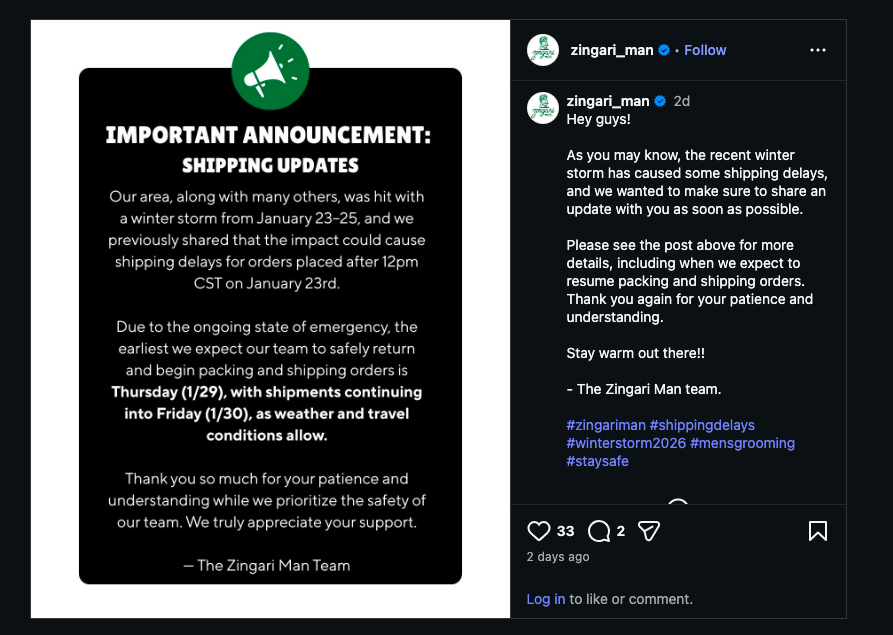
- During the peak season or storm conditions, the weather can get bad that delivery persons don’t attempt the final leg of delivery. Rather than surprising the customers with the news, you can pre-emptively notify them of expected weather delays in your checkout pages and order confirmation notifications.
- Due to cases of porch piracy, packages are at the risk of being stolen or simply damaged by miscreants. To avoid these incidents and the costs that come with them, you can follow the same practice of checking with the customer regarding their availability at the location to collect their orders safely.
4. Provide FAQs on Tracking Pages
Your customers might have a lot of questions regarding their out for delivery, what does “out for delivery” mean?, when will my package arrive, What if I’m not home? Or How can I reschedule delivery?
You can avoid support tickets being created for all such questions by adding a FAQ section on your tracking pages. You can make things even better by adding links that allow them to reschedule delivery, contact support, or the next relevant action based on their question.
Such actions ensure that you can reduce support tickets, lower support costs, and get higher customer satisfaction rates, thanks to customers now getting instant answers.
5. Technology & Tools Integration
When you’re shipping hundreds or thousands of packages per month, you can’t manually check tracking status, send individual notifications, or catch exceptions before they become customer complaints. This is where the right technology stack becomes not just helpful—but essential.
The difference between merchants who struggle with delivery-related support tickets and those who turn “out for delivery” into a competitive advantage? Automation and proactive delivery management.
Think about it: Your packages are moving through the final mile right now. Customers are refreshing tracking pages. Delivery exceptions are occurring. Every minute of delay in detecting and responding to issues increases the likelihood of a frustrated customer and a support ticket.
The good news? Modern delivery management technology can monitor every package in real-time, automatically communicate with customers at exactly the right moments, catch exceptions before customers notice them, and give you complete visibility into carrier performance—all without adding headcount to your operations team.
- Real-time carrier API integrations – Pull real-time tracking data for up-to-the-minute updates
- Automated notification system – Trigger multi-channel messages (email, SMS, push, WhatsApp) based on status changes
- Branded tracking experiences – Keep customers on YOUR domain with personalized tracking portals
- Exception management dashboard – Real-time alerts with one-click resolution workflows
- Analytics & reporting – Track carrier performance, delivery success rates, and customer satisfaction
The all-in-one solution: LateShipment.com’s Delivery Experience Management software, OneTrack, provides all these capabilities in a single platform specifically built for e-commerce merchants. OneTrack handles proactive notifications, exception monitoring, branded tracking, and performance analytics—while also automatically recovering shipping refunds when carriers miss delivery commitments.
The benefits are huge as well. E-commerce brands using proactive delivery management during the “out for delivery” stage see:
- 60% reduction in WISMO (“Where Is My Order?”) support tickets
- 40% decrease in delivery-related returns
- 23% increase in repeat purchase rates when customers receive excellent final-mile communication
- $4-7 saved per shipment through better exception management
Bottom line
The “out for delivery” stage isn’t something that just happens to your packages, it’s an active stage you must manage strategically. Merchants who master this stage see dramatically lower support costs, higher customer satisfaction, and stronger repeat purchase rates.
Start with proactive communication (biggest quick win), then layer in exception management, carrier accountability, and performance tracking. Your customers and your bottom line will thank you.
LateShipment.com is specifically built for ecommerce retailers such as yourself to deliver phenomenal post-purchase CX and measurable results, all while effortlessly recovering refund claims from your shipping carriers.
Interested? We at LateShipment.com can’t wait to help you grow your fanbase, savings, and business. Get in touch with our expert or write to us.
FAQs about Out for Delivery
1. What's the difference between "out for delivery" and "in transit"?
“In transit” means your package is moving between carrier facilities and hubs, potentially hundreds of miles away. “Out for delivery” means the package has reached the local distribution center and is loaded on a delivery vehicle heading to your customer’s address—typically within the same day.
2. How can I reduce WISMO tickets during the "out for delivery" stage?
Send proactive notifications when packages reach “out for delivery” status via email, SMS, or WhatsApp. Include the expected delivery timeframe, tracking link, and delivery instructions. Merchants using automated notifications see up to 60% reduction in “Where Is My Order?” support tickets.
3. What should I do if a package is stuck in "out for delivery" status for over 12 hours?
Set up automated alerts to catch this exception early. Contact your carrier immediately to investigate, then proactively communicate with your customer about the delay and provide an updated delivery timeframe. Don’t wait for customers to contact you first.
4. How much do failed deliveries actually cost my business?
In LateShipment.com’s research, we identified that failed deliveries cost $15-25 per incident when you factor in support time, reshipment fees, and potential lost sales. For a store shipping 1,000 packages monthly with a 3-5% failure rate, that’s $600-1,000/month in preventable costs—plus the long-term impact on customer lifetime value.
5. What are the most common delivery exceptions at this stage?
The top exceptions during “out for delivery” are: incorrect/incomplete addresses discovered during delivery, access issues (gated communities, businesses closed), customers unavailable for signature-required packages, final-mile weather delays, and package theft or damage during delivery.
6. What information should I include in "out for delivery" notifications?
Include tracking page link with expected delivery timeframe, list of products being delivered (helps with return decisions), delivery requirements (signature needed, adult must be present), delivery tips (gate codes, safe locations), and easy access to support contact options for last-minute changes.
7. Can I automate exception management for packages out for delivery?
Yes. Delivery management platforms like LateShipment.com’s OneTrack can automatically monitor packages, detect 13+ types of exceptions, alert your team before customers notice issues, and trigger appropriate customer communications—all without manual tracking.
8. How do I handle customers who won't be home during delivery?
In your “out for delivery” notification, provide options to: reschedule delivery through the carrier, authorize delivery without signature (if appropriate), specify a safe delivery location, or arrange delivery to an alternate address. Proactive communication prevents failed delivery attempts.