

Quick answer:
A branded tracking page is an order tracking page hosted on your own domain that shows real-time shipment status using your brand’s logo, colors, fonts, and messaging, instead of redirecting customers to a generic carrier page. It gives CX teams a self-serve tracking channel that cuts WISMO tickets by up to 72%, and gives marketing teams a high-attention surface to display product recommendations that generate 6-12% additional revenue per order. 90% of online shoppers actively track their packages, making the tracking page one of the most visited touchpoints in the entire post-purchase journey.
Key Takeaways
- For CX teams: A branded tracking page is a self-serve answer to the single biggest driver of post-purchase support tickets: ‘Where is my order?’ Customers who can track their order on your site without contacting support create fewer tickets and report higher satisfaction.
- For marketing teams: Customers visit the tracking page 3-5 times per order on average, making it one of the highest-attention real estate in the entire customer journey. Product recommendations and promotions placed here generate 6-12% in additional new revenue annually (LateShipment.com merchant data).
- Carrier pages are a brand leak: Every customer you send to a carrier’s tracking page is a customer who spends that attention on someone else’s domain. Branded tracking pages reclaim that touchpoint for your brand, your loyalty program, and your next sale.
- Must-have elements: A strong branded tracking page needs: real-time tracking status, visual delivery timeline, accurate Estimated Delivery Date (EDD), custom domain hosting, product recommendations, support channel access, and returns initiation. Most carrier tracking pages offer none of the last four.
- No code required: LateShipment.com’s OneTrack platform lets you build and launch a fully branded tracking page on your domain using drag-and-drop, with no developer time needed. It connects to 1,200+ carriers out of the box.
A whopping 90% of the customers actively track their packages with over 20% of them tracking multiple times in a day. This shows that despite receiving prompt and regular shipping notifications, customers tracking their own orders on tracking pages really puts ‘smile’ on their faces and delights them.
Thus, the need for eCommerce businesses to provide their customers with tracking pages is clear. However, not just any tracking page would do. Your self-hosted tracking pages need to be of the highest standards to not just meet but exceed customer expectations.
This is where ‘branded’ order tracking pages come in. But before we get to the best efforts required to provide branded order tracking experiences, let’s start by looking at how far eCommerce businesses have been able to keep up with customers’ package tracking expectations.
The Current State of Legacy Order Tracking Methods
Once the order gets shipped, the customer is sent a link that takes them to the carriers’ tracking page where they periodically track their orders as they unfold. However, this process is outdated and simply not the best for your business and brand building.
For more context, The significant downside here is that carrier tracking pages are:
- Off-brand
- Visually boring
- A marketing dead-end (does not encourage any further brand interaction)
Worry not though. There’s a better way to do tracking.
Rather than taking your customers to the carrier’s tracking page, you can direct them to your own tracking page that can help you provide post-purchase experiences that are on-brand and can also be your eCommerce store’s next marketing advantage.
In order to make things work a lot better in your favor, you need to provide ‘branded tracking pages’ that improve brand experience, inspire loyalty, and increase sales. But first what exactly is a branded tracking page?
What is a Branded Tracking Page?
A branded order tracking page is a tracking page hosted on your e-commerce website that enables your customers to track their online orders in real-time.
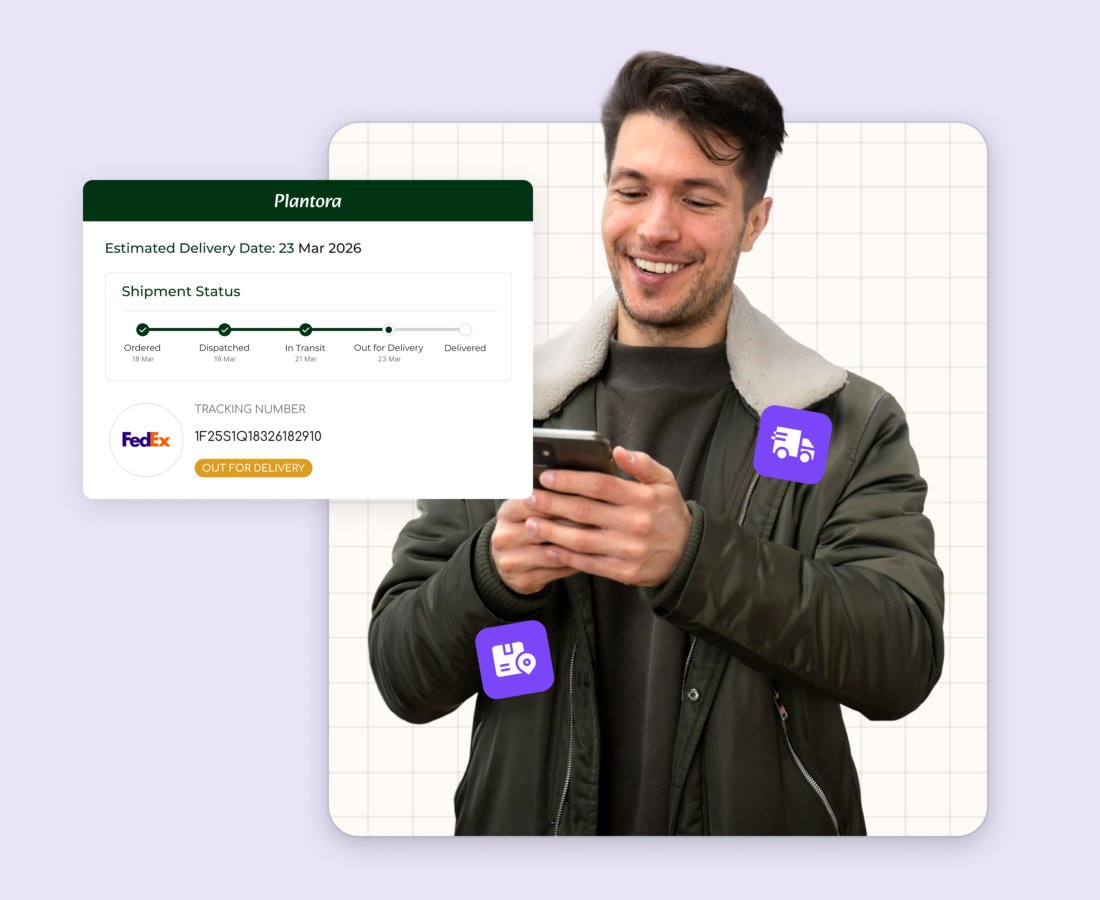
Apart from the usual content of delivery timeline, tracking details, real-time order status updates, and so on, a branded tracking page also contains your brand elements such as logo, font, and color schemes to extend the branded experience from the product pages. Your branded tracking pages can also contain personalized product recommendations and promotions to drive repeat sales.
For CX teams, it is the self-serve answer to WISMO. For marketing teams, it is a high-attention advertising surface visited more times per order than almost any other page on your site.
Why Branded Tracking Pages Matter: CX and Marketing Perspectives
For CX Teams: Self-Service That Cuts Tickets Without Cutting Corners
WISMO queries (‘where is my order?’) account for around 70% of post-purchase customer support inquiries at most e-commerce brands. Every one of those tickets is a customer who could not find the information they needed without contacting support.
A branded tracking page with real-time status, accurate EDD, and proactive delay alerts converts those reactive support contacts into self-serve tracking sessions. The outcome is measurable: LateShipment.com merchants report up to 72% fewer WISMO tickets after deploying a branded tracking page with proactive notification workflows.
Beyond ticket volume, there is a customer satisfaction dimension. Customers who experience a consistent, branded tracking journey report higher satisfaction scores than those sent to generic carrier pages. The tracking phase is an anxiety window. Customers want reassurance. A branded tracking page with clear progress indicators delivers that reassurance on your brand’s terms.
For Marketing Teams: The Most Underused Paid-Traffic-Free Channel You Already Have
The branded tracking page is one of the highest-attention surfaces in your entire customer lifecycle. Customers return to it 3-5 times per order on average. Unlike a homepage visit or a product page view, the tracking page visit is intentional and high-intent: the customer has already bought, is already engaged with your brand, and is in a positive anticipation mindset.
This is the environment where product recommendations convert. LateShipment.com merchants who run targeted product recommendations on their branded tracking pages report 6-12% in additional new revenue annually. That revenue requires no paid media, no new audience, and no additional marketing spend. It comes from the customers you already have, at the moment they are most engaged with your brand.
Beyond revenue, the tracking page is the right place to surface loyalty program enrollment, referral programs, and newsletter subscriptions. A customer who has just had a positive purchase experience is significantly more likely to join your loyalty program than one who has never bought from you. The tracking page is where that moment happens.
What a Branded Tracking Page Should Include
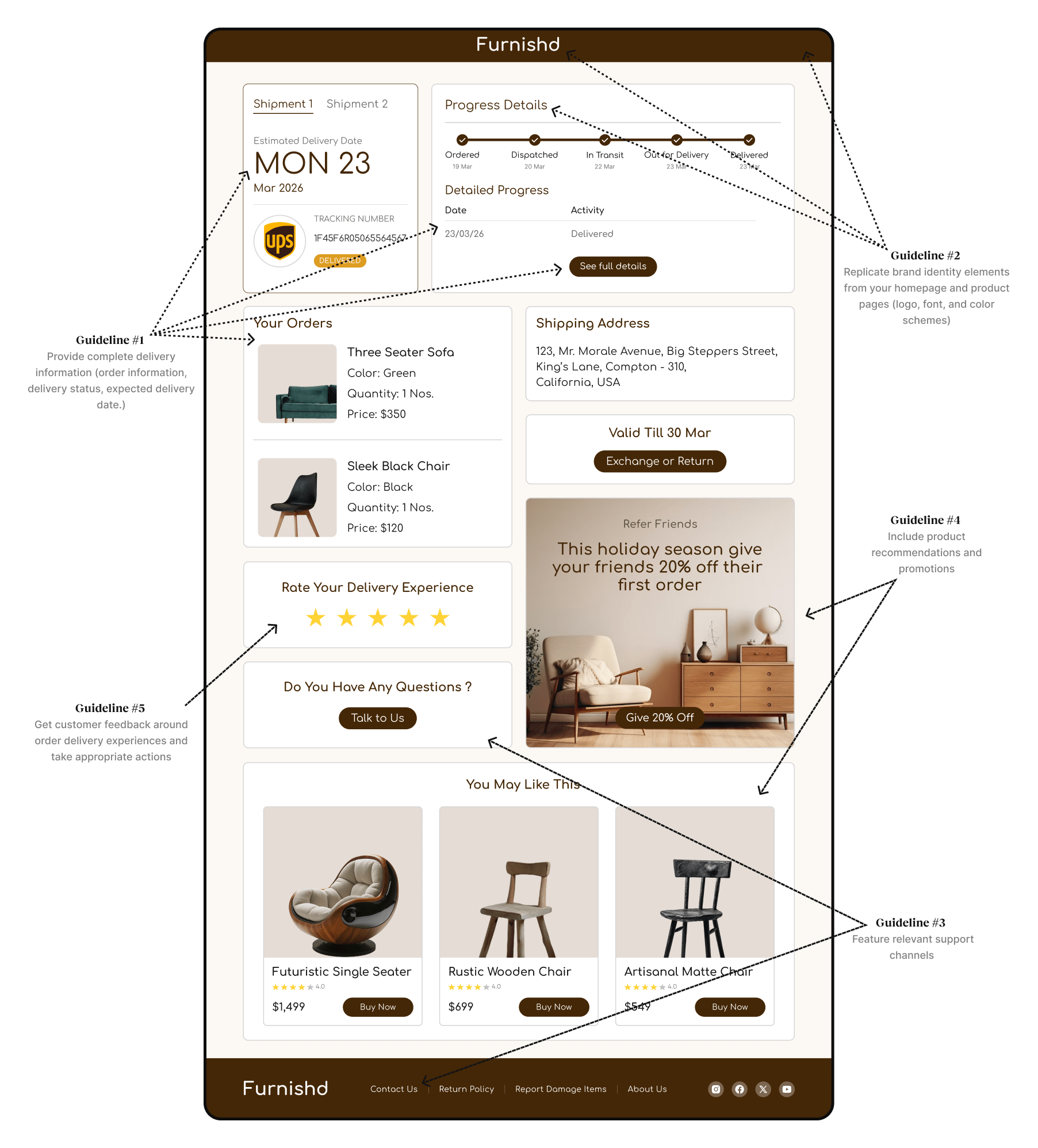
Guideline #1 – Provide complete delivery information
- First and foremost, don’t miss out on providing your customers with all the essential information that is usually available on order tracking pages.
- This can include the complete order delivery status in reverse chronological order, expected delivery date, current order status (Shipped / In-transit / Delivered), etc, order information (number / size), and more.
Impact – Reduce Delivery Related Customer Enquiries (WISMO Calls) With Self-Service Order Tracking Pages
Guideline #2 – Replicate brand identity elements from your homepage and product pages
- Make your order tracking pages an extension of the product purchasing journey. Include all the fonts, color schemes, design templates, etc
Impact – Keep customers connected with your brand experience even in the post-purchase, order delivery phase. Brand immersive tracking experiences delight your customers and drive higher ROI.
Guideline #3 – Feature relevant support channels
- Your customers would want to talk to your support team regarding additional information regarding product-related queries, return policy, etc
- In such cases, instead of making the customer search and locate relevant customer support channels, you can enable them to directly reach out from the order tracking page
- For instance, you can provide options for your customers to chat with your support reps, including product usage information, easy returns initiation, etc.
Impact – Reduce customer anxiety by taking the hassle out of support queries via seamless engagement and instill confidence in your customers.
Guideline #4 – Include product recommendations and promotions
- As mentioned, customers track their orders 6-8 times before delivery. This implies that branded order tracking pages are a great way to highlight your upsell and cross-sell your products via personalized promotions and recommendations.
- You can also use your tracking page to offer discounts and include other marketing assets to lead your customer back to your online store.
Impact – When it is made to its fullest use, custom tracking pages can help you leverage order tracking moments to increase repeat sales (by opening upselling and cross-selling opportunities).
Guideline #5 – Get customer feedback around order delivery experiences and take appropriate actions
- Capture your customers’ delivery experience ratings after every order delivery
- Analyze the average ratings of customers to optimize shipping & delivery operations
Impact – Decode customer actions post-purchase and evaluate your carriers’ performances to perfect your post-purchase strategy.
Following these time-tested practices to manually create branded tracking pages on your own is good. But there’s a better way to do this.
You can make use of a delivery experience management solution such as LateShipment.com that helps you effortlessly build custom branded tracking pages on your domain via drag-and-drop options.
Build Branded Ecommerce Tracking Pages with Lateshipment.Com
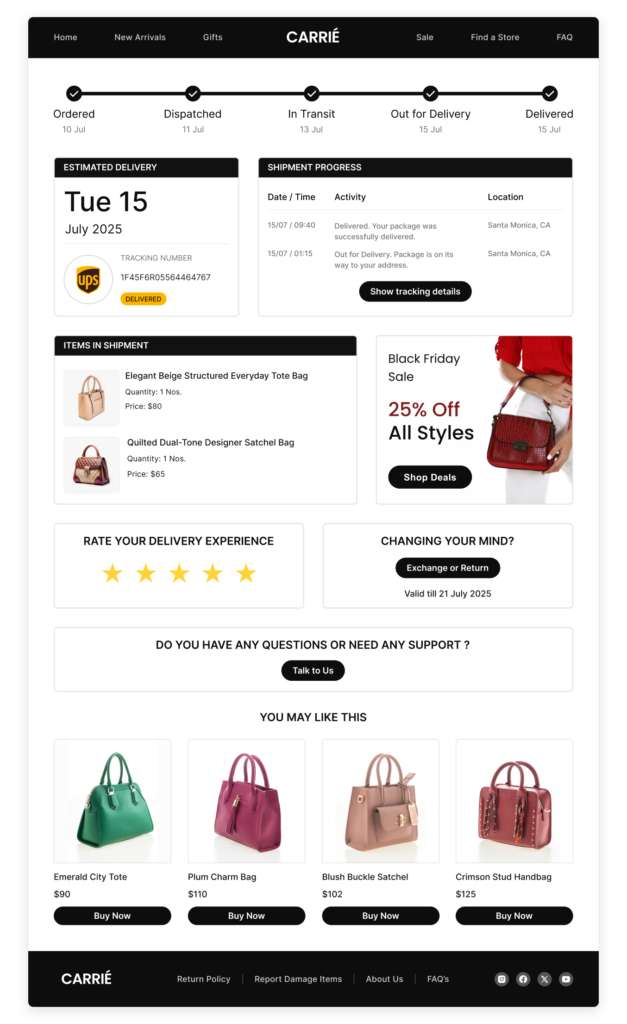
LateShipment.com’s Delivery Experience Management platform (DEM) platform is chock-a-block filled with benefits for your business to provide an on-brand post-purchase experience. Read on to explore the benefits for merchants and customers alike via branded tracking pages.
Benefits for the merchant
- Control your experiences to be in line with your ecommerce website product pages and tracking pages and prevent them from being disconnected from the brand experience.
- Carrier tracking pages don’t have upselling features while LateShipment.com helps you increase sales with marketing campaigns & product recommendations on tracking assets.
- Engage with the customer via ‘how-tos’ and product guides to reduce unnecessary returns.
- Advertising is the biggest advantage but you can as well include referring a friend and newsletter subscription columns as additional benefits.
- Collect delivery feedback and understand how the delivery experience was for the customer.
Benefits for the customer
- Live package tracking – access to the package at all times.
- One place to access everything about their package – Order details, etc.
- Have an extended shopping experience – seamless purchase and post-purchase experiences.
- Initiate order returns directly from the tracking page.
That’s not all! There are other ways LateShipment.com can help your business in the form of delivery and returns management and automated parcel audit solutions (spoiler alert – helps you save up to 20% on your shipping costs).
But for now, here’s how we can help you start creating branded eCommerce tracking pages.
- Create a LateShipment.com account – Simply create an account with your email id and password to get started with our DEM platform set up.
- Set up real-time shipment tracking – Add your shipment data source (Shipping Carriers, Ecommerce Platform, or Order Management System)
- Get started without any coding hassles – Follow the on-screen instructions to start creating branded tracking experiences on your store.
Bottom Line
For modern ecommerce customers, branded order tracking is no longer a USP but a standard offering.
Missing out on letting your customers track their orders on your tracking pages means missing out on creating a positive post-purchase CX.
With a custom-built branded order tracking page, you can extend your brand experience with customers, post-purchase, and stay on top of your customers’ minds.
You can also use it to increase sales, reduce returns, and most importantly understand how your customers perceive your brand.
FAQs about Branded Tracking Pages
What is a branded tracking page?
A branded tracking page is an order tracking experience hosted on your own domain (for example, tracking.yourbrand.com) that shows customers real-time shipment status using your brand’s visual identity: logo, colors, fonts, and messaging. Unlike a generic carrier tracking page, a branded page keeps customers on your website, displays product recommendations, provides support channel access, and gives you full control over the post-purchase brand experience.
How does a branded tracking page reduce WISMO tickets?
A branded tracking page is an order tracking experience hosted on your own domain (for example, tracking.yourbrand.com) that shows customers real-time shipment status using your brand’s visual identity: logo, colors, fonts, and messaging. Unlike a generic carrier tracking page, a branded page keeps customers on your website, displays product recommendations, provides support channel access, and gives you full control over the post-purchase brand experience.
Can a branded tracking page generate revenue?
Yes, directly. Customers visit the tracking page 3-5 times per order on average. Placing relevant product recommendations and promotions on that page converts passive tracking visits into purchase moments. LateShipment.com merchants running product recommendations on their branded tracking pages report 6-12% in additional new revenue annually. That revenue requires no paid media spend. It comes from customers who are already in a positive, post-purchase mindset during a highly engaged session.
What should a branded tracking page include?
At minimum: real-time tracking status, a visual delivery timeline or progress bar, an accurate Estimated Delivery Date, and your brand’s logo and color scheme on a custom domain. To maximize both CX and marketing value, also include: personalized product recommendations, promotions or loyalty program prompts, direct support channel access, and returns initiation capability. LateShipment.com’s OneTrack platform covers all of these with no developer setup required.
What is the difference between a branded tracking page and a carrier tracking page?
A carrier tracking page (such as ups.com/track or fedex.com/tracking) is hosted on the carrier’s domain, shows only raw shipment data, carries no brand identity from the retailer, has no product recommendations or marketing capability, and offers no support access tied to the retailer. A branded tracking page is hosted on the retailer’s own domain, displays the retailer’s branding throughout, shows product recommendations, gives access to the retailer’s support team, and can initiate returns. From a brand experience perspective, a carrier tracking page is where brand continuity breaks. A branded page is where it is maintained.
Does setting up a branded tracking page require developer resources?
Not with LateShipment.com. The OneTrack platform uses drag-and-drop configuration to build and launch a branded tracking page on your domain. You connect your shipment data source (carrier, e-commerce platform, or OMS), configure your brand elements, and the tracking page is live. The entire setup takes under 30 minutes with no developer involvement. LateShipment.com connects to 1,200+ carriers out of the box, so multi-carrier brands do not need to configure individual integrations.
How do branded tracking pages help marketing teams specifically?
The tracking page is one of the highest-attention brand surfaces in the customer lifecycle because the visit is intentional: the customer chose to check their order. Marketing teams can use this attention for: product recommendations (6-12% additional annual revenue), loyalty program enrollment prompts (captures customers at peak positive sentiment), referral program links (peer recommendations from engaged buyers), newsletter subscriptions (opt-in at a moment of high brand engagement), and discount codes for the next purchase (accelerates the second purchase timeline). None of this requires paid media. It is incremental revenue from traffic you already have.