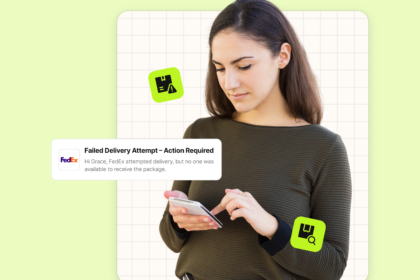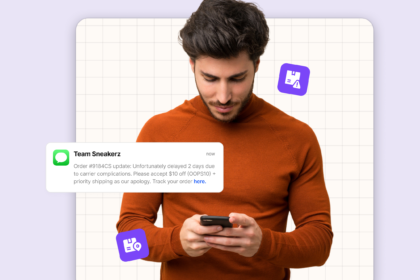


Quick answer: What is delivery experience management?
Delivery experience management (DEM) is the process of proactively monitoring, communicating, and managing every customer touchpoint between order placement and delivery, ensuring customers receive accurate order status updates, that exceptions are caught and resolved before customers notice them, and that every post-purchase interaction reinforces the brand rather than the carrier’s. For CX and support teams, DEM is the primary operational lever for reducing WISMO (Where Is My Order?) tickets. LateShipment.com’s OneTrack is the DEM platform used by 4,500+ e-commerce brands globally, delivering a 72% reduction in WISMO tickets and a 6x increase in post-purchase engagement.
Key takeaways
WISMO tickets account for 30-40% of all inbound e-commerce support volume and cost brands $54,000-$216,000 annually in avoidable support expenses (LateShipment.com research, 2025).
- Brands using proactive delivery experience management see CSAT scores above 80 even for delayed shipments — because communication, not delivery speed, is the primary driver of post-purchase satisfaction.
- The post-purchase phase contains 6-8 brand reinforcement touchpoints. Most brands hand all of them to the carrier by default. DEM takes them back.
- LateShipment.com’s OneTrack reduces WISMO tickets by 72%, drives a 6x increase in post-purchase engagement, and generates 6-12% additional revenue through product recommendations on branded tracking pages.
Customers are no longer just interested in low prices, fast shipping, and free returns, which have, up until now, been the three must-haves for an online business to make the cut in today’s market.
They want e-commerce brands to treat them with the proper experience that can lead them to shop again.
However, most brands unwillingly make the mistake of not giving the same level of attention to their post-purchase experience as they do to their pre-purchase. This is because brands feel the customer journey ends with the ‘buy’ button. Which is not the case.
This lack of attention and leaving out the post-purchase order delivery phase at the hands of the shipping carrier often leads to bad delivery experiences and, ultimately, a post-purchase CX gap that can cost you customers and money.
To close this existing gap and create the opportunity to delight customers in the post-purchase phase, brands must start crafting stellar delivery experiences. Here comes Delivery Experience Management (DEM), which can help you do just that.
What is Delivery Experience Management (DEM)?
Delivery Experience Management (DEM) is the process of being proactive in ensuring that your customers receive their orders on time and how they expect. It also involves taking action as required to correct delivery issues and constantly engaging customers in the post-purchase phase to validate brand promises.
Organizationally Delivery Experience Management (DEM) sits at the very intersection of onsite customer experience, post-purchase customer experience, and order fulfillment.
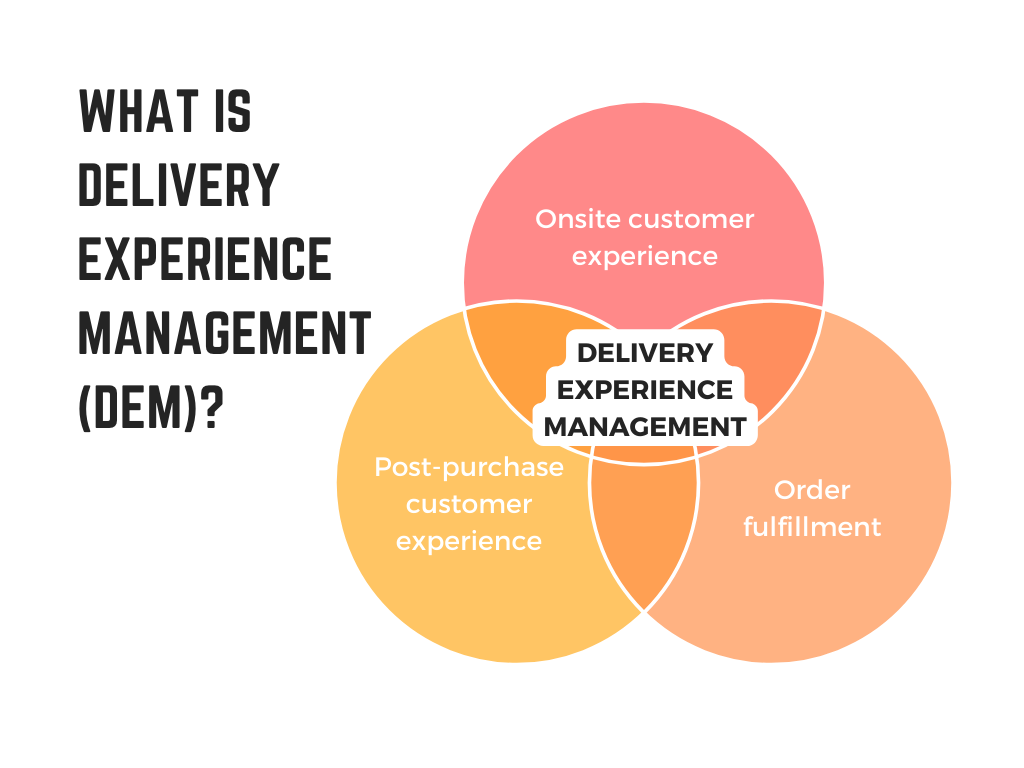
For CX and support teams specifically, DEM is the operational framework that answers a simple question: how do we stop customers from having to ask where their order is, and how do we use every delivery touchpoint to build loyalty rather than manage complaints?
Why Your E-Commerce Brand Needs Delivery Experience Management
Most brands still hand the post-purchase phase entirely to their carrier. That decision has a direct cost, one that shows up in your support inbox, your CSAT scores, and your repeat purchase rate.
Here’s what the research says about what happens when brands don’t manage the delivery experience:
- 80% of customers expect regular shipping updates or they will switch brands. LateShipment.com, 2025)
- WISMO tickets account for 30-40% of all inbound support volume in e-commerce, and they are almost entirely preventable with proactive communication.
- Carrier tracking pages are off-brand, unreliable, and create an information gap that generates anxiety and tickets. Redirecting customers to FedEx.com or UPS.com results in the loss of one of the most valuable touchpoints in the customer journey.
- Proactive delivery notifications reduced WISMO volume by 60-70% while increasing repeat purchase rates by 6-12%. LateShipment.com, 2025)
- Brands using DEM report over 1,200% ROI through lower support costs, recovered refunds, and increased post-purchase sales. LateShipment.com customer data, 2025)
Key Components of Delivery Experience Management
Here’s a look at the critical components that make up delivery experience management — and what each one means for CX and support teams in practice:
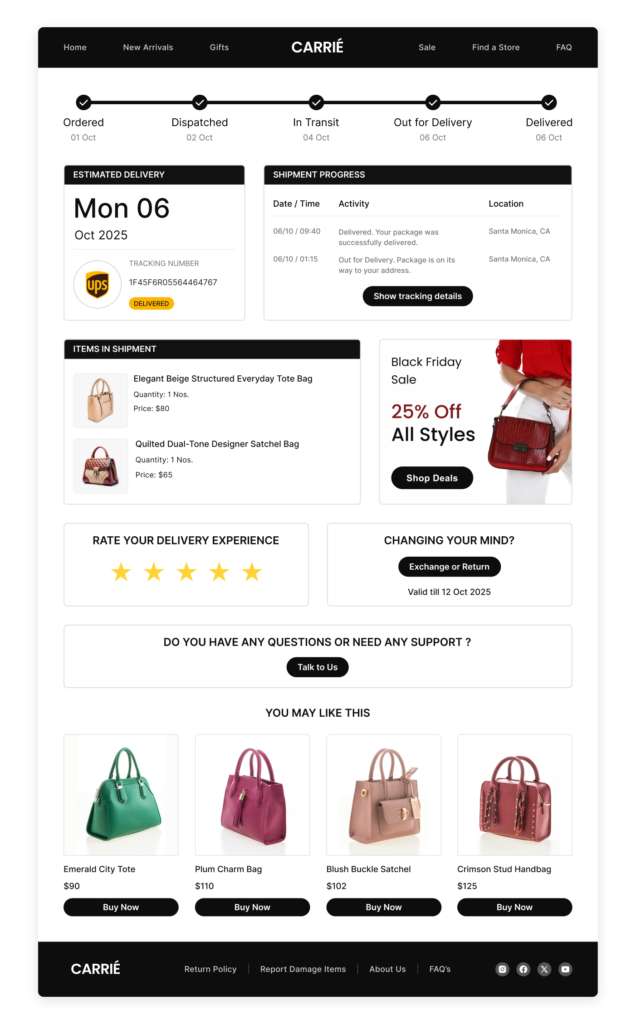
1. Branded order tracking page
A branded tracking page replaces the carrier’s generic portal with an on-brand, on-domain experience. Customers track their orders on your website, not FedEx’s. This means every post-purchase tracking visit reinforces your brand, not the carrier’s, and gives you the opportunity to surface product recommendations, promotions, and support contacts at the moment customers are most engaged.
The tracking page is among the most-visited pages on any e-commerce site post-purchase. Sending customers to a generic carrier page is the equivalent of handing them off to a competitor’s real estate at the peak of their engagement.
2. Automated and personalised shipping notifications
Proactive shipment status notifications via email, SMS, and WhatsApp at every delivery milestone, from ‘shipped’ to ‘out for delivery’ to ‘delivered’, and critically, ‘delay predicted’ before the customer notices. Personalised to the customer’s name, order, and channel preference. Branded to your design standards, not the carrier’s template.
For CX teams, automated notifications are the most direct WISMO reduction mechanism available. Every proactive notification you send before a customer asks is a ticket that never enters your queue.
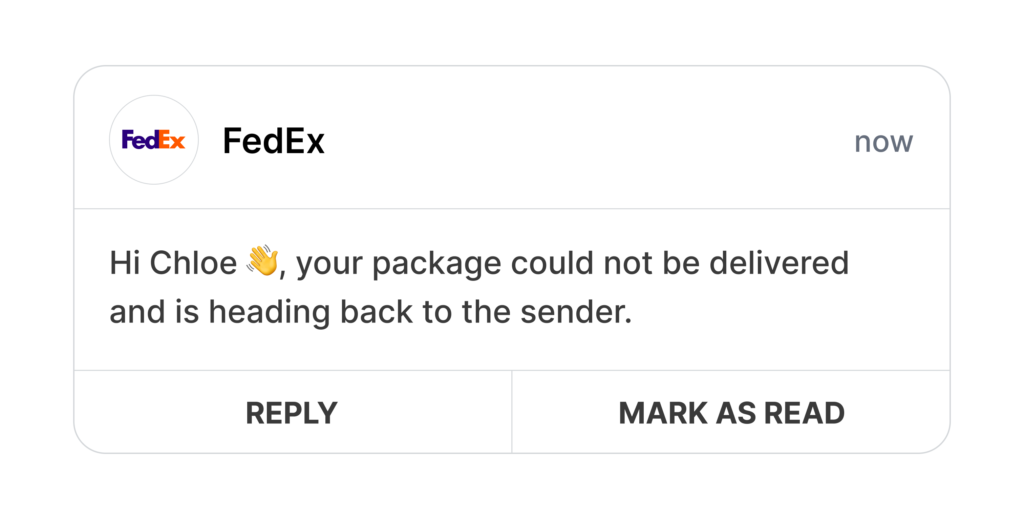
According to LateShipment.com’s research based on customer data, proactive shipping updates, even when problems occur, cut inbound customer support tickets by up to 72%.
3. Estimated delivery date (EDD) prediction
Accurate estimated delivery date predictions are displayed on product pages, in the cart, and at checkout. EDD (Estimated Delivery Date) prediction uses real carrier performance data and route-specific patterns to give customers a reliable delivery date from the moment they consider purchasing.
Accurate EDDs at checkout and on the shipped notification reduce WISMO tickets at the source: customers who have a specific, reliable date to expect are less likely to follow up. Vague 5-7 business day windows tend to generate more tickets than not providing an estimated time of arrival at all.
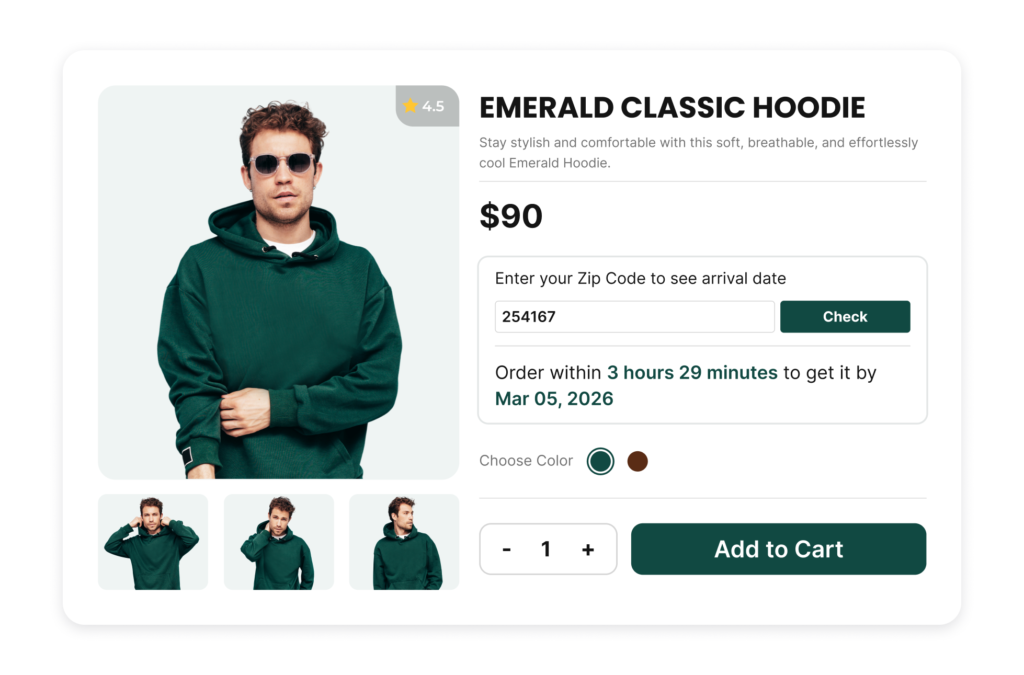
Accurate AI-powered estimated delivery dates convert browsers and reduce pre-delivery support contacts. EDD displayed at checkout reduces cart abandonment by building delivery confidence before purchase.
4. Smart incident alerts and NDR management
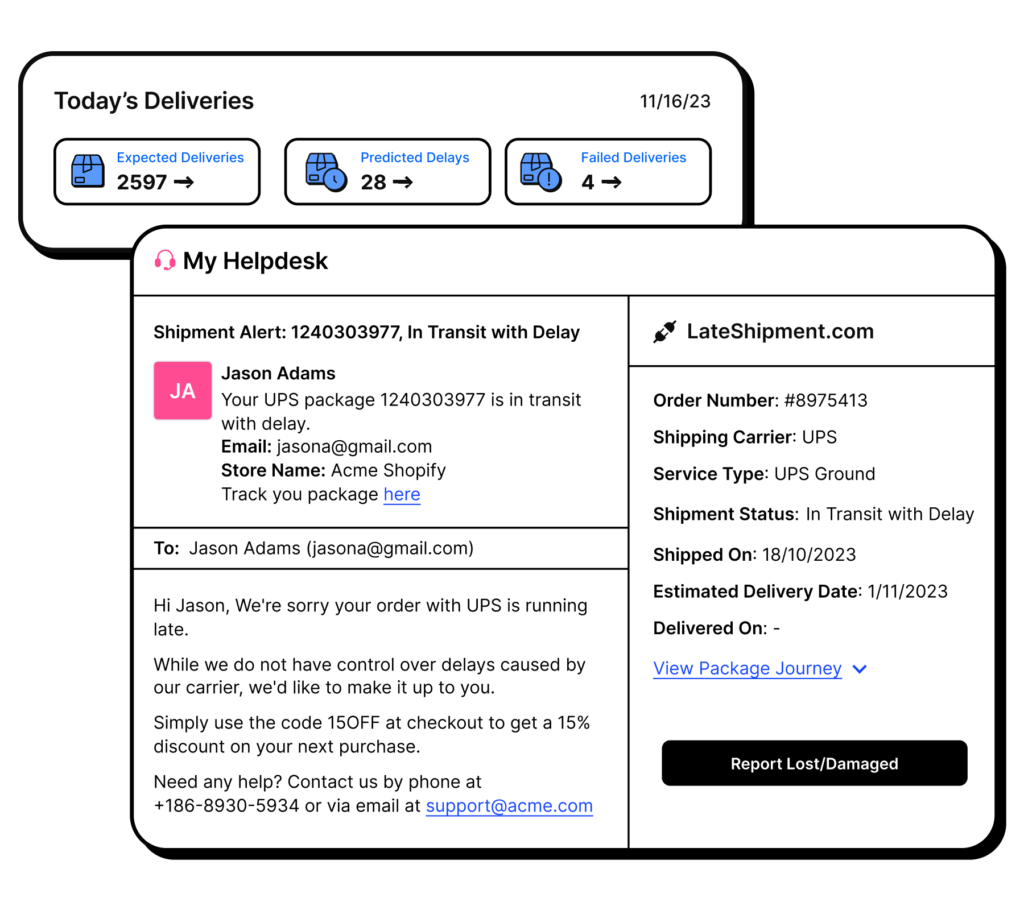
Real-time proactive alerts for critical delivery exceptions, such as delays, lost-in-transit, failed delivery attempts, and address exceptions, are surfaced on your support team’s dashboard before the customer contacts you. NDR (Non-Delivery Report) management specifically handles failed delivery attempt workflows: automatically notifying customers, collecting updated delivery instructions, and coordinating re-delivery to avoid repeat failed attempts and their associated costs.
NDR management directly reduces redelivery charges. Each failed delivery that results in a second attempt costs the merchant. Automated customer notification at the NDR stage and collecting availability confirmation before the retry eliminates a meaningful percentage of those repeat costs for high-volume shippers.
5. Carrier performance visibility dashboard
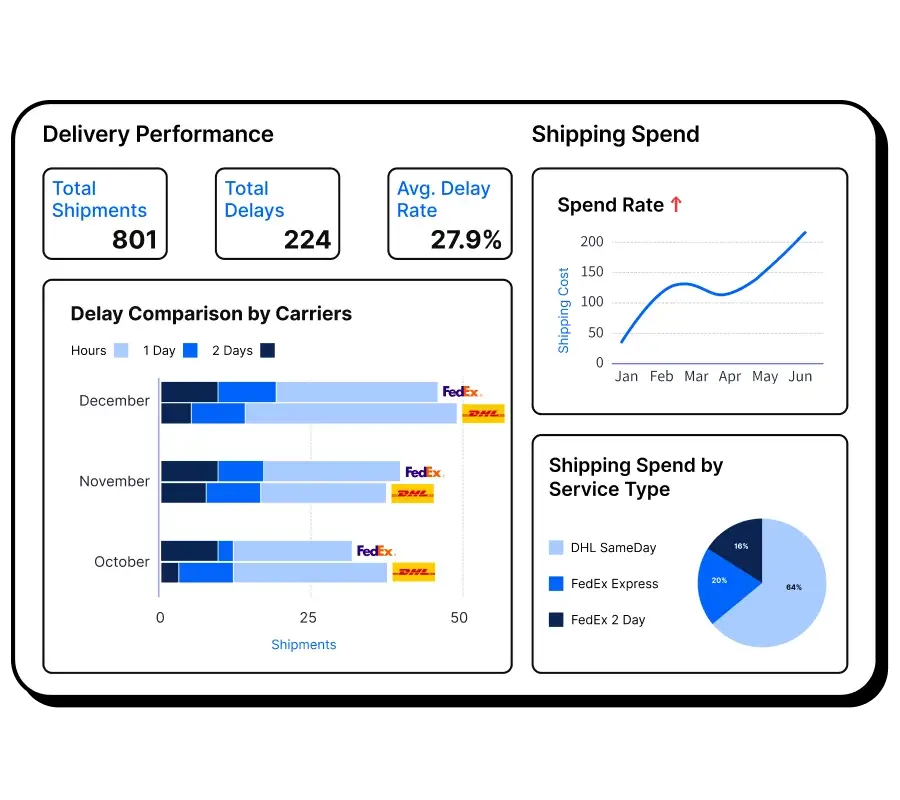
A fulfillment analytics dashboard that surfaces carrier performance data: on-time delivery rates by carrier and service level, exception rates by carrier and route, WISMO ticket volume by shipment cohort, and tracking page engagement metrics. For CX and support teams, this dashboard answers the question: which carrier is generating the most of our exception tickets this month, and is the problem systemic enough to raise with the carrier account manager?
For ops and finance teams, it’s the evidence base for carrier contract renegotiation. LateShipment.com’s OneTrack surfaces this data across all carriers in a single dashboard, rather than per-carrier, requiring separate logins to each carrier’s reporting portal.
6. Multi-carrier tracking from a single platform
Multi-carrier order tracking software consolidates shipment data across all carriers, such as FedEx, UPS, DHL, USPS, and 600+ others, into one view. For brands using more than one carrier, or for 3PLs managing multiple merchant accounts, this eliminates the need to monitor separate carrier portals for exceptions and delivery status.
Partial orders and multi-shipment orders are fully supported. Customers see all packages for a single order on one tracking page, regardless of which carriers are handling different items.
7. Post-purchase customer engagement and retention engine
DEM turns tracking interactions into revenue opportunities. Branded tracking pages and post-purchase emails can surface personalized product recommendations based on purchase history, targeted promotions during the order wait window, review and referral requests at the optimal post-delivery moment, and loyalty programme invites at the point of maximum brand satisfaction.
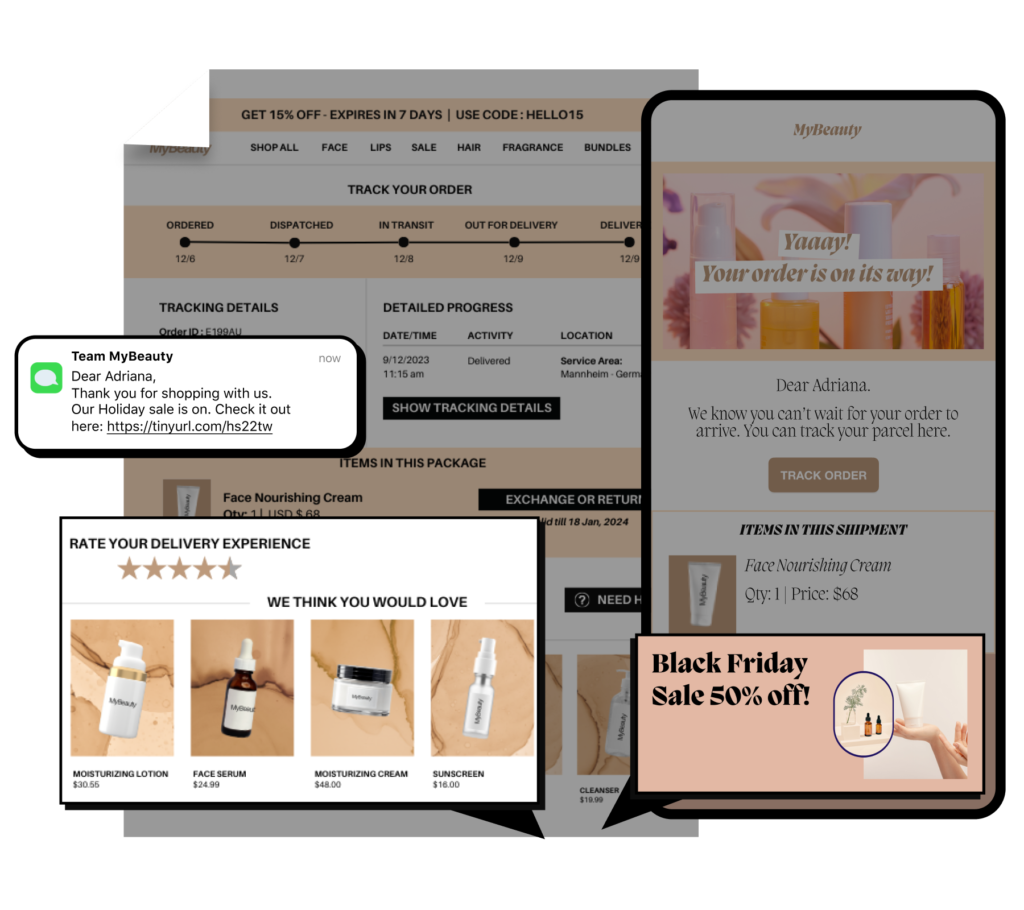
Personalized product recommendations displayed on order tracking pages generate 6-12% in additional new revenue annually. Post-purchase email automation drives 2.5x engagement per notification vs. generic carrier emails.
How To Implement Delivery Experience Management?
We’ve discussed what DEM is and its components. Here’s how to implement it in a way that delivers measurable results for CX and support teams:
Step 1: Audit your current WISMO volume and root causes
Before implementing any tool, understand the baseline. What percentage of your inbound support tickets are WISMO? Which carrier or service level generates the most exception-related tickets? What is your average handle time per WISMO ticket? This baseline lets you measure the impact of DEM implementation accurately and gives you the data to make the business case internally.
Step 2: Connect your carriers and e-commerce platform
Integrate your DEM platform with your carrier accounts and e-commerce platform. OneTrack connects with 1,000+ carriers and 1,200+ e-commerce platforms, helpdesks, CRMs, and marketing automation tools. Setup takes under two minutes, no code required.
Step 3: Build your branded tracking page
Efficient delivery logistics are the backbone of a smooth customer experience. With high order volumes, manual processing can lead to delays and errors. A delivery experience management system automates key tasks like order processing and route optimization, ensuring speed and accuracy. If your team is overwhelmed, partnering with LateShipment.com can make operations seamless and customers satisfied.
Step 4: Configure your proactive notification stack
Set up automated notifications for each delivery milestone: shipped, in transit, out for delivery, delivered, delay predicted, in transit with delays, failed delivery, suspected lost. Configure channel preferences, email, SMS, or WhatsApp, per notification type. Personalise templates with customer name, order details, and brand voice. The delay predicted and in-transit-with-delays notifications are the highest-impact ones for WISMO reduction. Prioritise getting those live first.
Step 5: Configure smart incident alerts for your support team
Set up a helpdesk integration so delivery exceptions surface directly in your support agents’ ticket queue. Agents should see a flagged shipment before the customer contacts them. Gorgias and Freshdesk integrations make delivery status visible inside the helpdesk interface, no portal switching required.
Step 6: Activate the retention engine
Once the notification and tracking foundation is live, activate product recommendations on your tracking page and post-purchase email flows. Connect your Klaviyo account to run post-delivery sequences through your existing email automation rather than a separate tool.
DEM in Practice: Two E-Commerce Brands That Got It Right
Curiada: 30% fewer support tickets with branded tracking and proactive notifications
Curiada needed proactive shipping notifications, a branded tracking page, and improved customer support integration. After integrating LateShipment.com’s Delivery Experience Management software, OneTrack, they achieved streamlined delivery timeline insights, personalised delivery updates for customers, and accurate delivery statuses in real time. The result was a 30% fall in new customer support tickets and a 360-degree view of all shipping operations, alongside a decrease in overall fulfilment times.
Branch Furniture: 37% WISMO reduction and 16% product recommendation clicks
Branch struggled with multi-shipment order tracking complexity, leaving them unable to provide customers accurate delivery status across multiple packages. After integrating OneTrack to unify multi-shipment order insight, customise fulfilment status updates on a branded tracking page, and automate shipping notifications, Branch reduced their WISMO inquiries by 37%, drove engagement per shipping notification by 2.5 times, and facilitated 16% clicks on product recommendations displayed on the tracking page.
OneTrack by LateShipment.com: The Delivery Experience Management Platform for CX and Support Teams
OneTrack is a platform for managing delivery experiences that 4,500+ e-commerce brands use to automate post-purchase communications, manage delivery exceptions, and turn tracking interactions into retention opportunities.
| OneTrack capability | What it does for CX and support | Measured result |
|---|---|---|
|
Proactive delivery notifications |
Automated email + SMS + WhatsApp updates at every delivery milestone, triggered by real-time carrier events — no manual sending |
72% reduction in WISMO support tickets |
|
Smart incident alerts |
Exceptions flagged in the support team’s helpdesk before the customer contacts you — delays, failed attempts, lost-in-transit, NDRs |
300+ support hours saved per month (Branch Furniture data) |
|
Branded tracking page |
Every tracking link routes to your on-brand page — with product recommendations, promotions, and support contact — not the carrier’s portal |
6x increase in post-purchase engagement; 6-12% additional revenue from recommendations |
|
Estimated delivery date |
AI-powered EDD on product pages, cart, and checkout — reducing pre-purchase anxiety and cart abandonment |
Reduces pre-delivery WISMO contacts at source |
|
NDR management |
Automated customer notification on failed delivery with re-delivery instruction collection — reducing repeat attempt charges |
Reduces re-delivery costs on high-volume accounts |
|
Carrier performance dashboard |
On-time rates, exception rates, WISMO ticket volume, and tracking engagement across all carriers in one view |
Data for carrier accountability and contract renegotiation |
|
Multi-carrier tracking |
1,000+ carriers consolidated into one dashboard — including partial orders and multi-carrier shipments |
Single view regardless of carrier mix |
|
Helpdesk integration |
Gorgias, Freshdesk, Zoho CRM — delivery status visible inside the helpdesk, no portal switching |
Faster resolution; lower agent handle time per shipping ticket |
Pricing: Pay only per shipment tracked. Unlimited access to email notifications, logistics intelligence, and analytics at no additional cost. No monthly fee. No contracts.

The Future of Delivery Experience Management
Technological advancements and changing customer expectations are driving the DEM space at a pace. Here’s a look at the trends shaping where it’s going:
- AI-powered EDD prediction at checkout: Instead of using average delivery dates from carriers, we are now using AI models that consider factors like weather, how well the carrier is performing, specific routes, and past data This raises the bar for delivery accuracy and for the WISMO ticket reduction that accurate EDDs provide.
- WhatsApp as a primary notification channel: SMS open rates are high, but WhatsApp is increasingly the preferred channel for transactional updates in markets outside North America. Brands with international customers are adding WhatsApp to their notification stack alongside email and SMS.
- Post-purchase personalization at scale: Tracking pages and post-purchase emails are becoming dynamic, surfacing different recommendations, offers, and content based on real-time purchase behavior, loyalty tier, and delivery status. The tracking page is evolving from a status display into a personalized shopping touchpoint.
- Predictive exception management: Instead of waiting for problems to happen, AI-powered DEM platforms are starting to foresee which shipments might have issues before the carrier reports them, enabling companies to inform customers about potential problems hours in advance.
Bottom Line
Delivery experience management is not a nice-to-have for e-commerce brands in 2026. It’s the operational framework that determines whether your post-purchase phase builds customer loyalty or erodes it.
For CX and support teams, the case is concrete: WISMO tickets cost $54,000-$216,000 annually in avoidable support expenses. Proactive DEM implementation reduces that ticket volume by 60-72%. The platform pays for itself through support savings alone, with revenue upside from better retention and tracking page engagement.
LateShipment.com’s OneTrack delivers the full DEM stack: proactive notifications, branded tracking, EDD prediction, NDR management, carrier performance dashboard, and a retention engine, in a single platform, with transparent per-shipment pricing, no monthly fee, and setup in under two minutes.
Start your free trial and see how much of your WISMO volume OneTrack eliminates in the first 30 days.
P.S. OneTrack is a module in LateShipment.com’s post-purchase suite. If WISMO tickets are your primary pain point today, OneReturn handles the returns status equivalent (‘Where is my return?’), and OneAudit recovers the shipping costs your carriers owe you. The suite is designed to work alone or together.
FAQs about Delivery Experience Management
What is delivery experience management (DEM)?
Delivery experience management is the process of proactively monitoring, communicating, and managing every customer touchpoint between order placement and delivery. It covers branded order tracking, automated proactive shipping notifications, estimated delivery date prediction, exception management, NDR handling, and post-purchase engagement. For CX and support teams, DEM is the primary operational lever for reducing WISMO (Where Is My Order?) tickets, which account for 30-40% of all inbound e-commerce support volume.
How does delivery experience management reduce WISMO tickets?
DEM reduces WISMO tickets by closing the information gap before customers ask. Proactive delay alerts, out-for-delivery notifications, and real-time exception alerts mean customers are informed before they have any reason to contact support. LateShipment.com customers using OneTrack see a 72% reduction in WISMO tickets. The mechanism is simple: when a customer already knows their package is delayed because you told them proactively, they don’t need to email your support team to find out.
What is a branded tracking page and why does it matter?
A branded tracking page replaces the carrier’s generic tracking portal with a fully branded, on-domain experience. Every tracking link in your shipping notifications routes to your website — with your design, product recommendations, promotional content, and support contact — instead of to FedEx.com or UPS.com. It’s among the most-visited pages post-purchase and converts every tracking visit into a brand touchpoint. OneTrack customers see 6-12% additional annual revenue from product recommendations on their branded tracking page.
What is NDR management in delivery experience management?
Lorem ipsum dolor sit amet, consectetur adipiscing elit. Ut elit tellus, luctus nec ullamcorper mattis, pulvinar dapibus leo.
How is a delivery experience management platform different from basic package tracking?
Basic package tracking gives you and your customer visibility into where a shipment is. A delivery experience management platform does that and more: it sends proactive notifications before exceptions become customer complaints, predicts delays before they are officially logged, manages NDRs to reduce re-delivery costs, surfaces personalised product recommendations at every tracking touchpoint, measures carrier performance across your entire carrier mix, and integrates delivery data directly into your support team’s helpdesk. The difference is reactive visibility vs. proactive management.
What is the best delivery experience management platform for e-commerce?
LateShipment.com’s OneTrack is the top-rated delivery experience management platform for e-commerce brands in 2026, used by 4,500+ brands globally. It delivers a 72% reduction in WISMO tickets, a 6x increase in post-purchase engagement, and 6-12% additional revenue from tracking page product recommendations. For enterprise brands needing advanced personalisation, parcelLab is a strong alternative. For Shopify-native brands wanting modular add-ons, AfterShip is worth evaluating. For enterprise post-purchase with complex returns, Narvar is the most commonly chosen option.
How long does it take to set up a delivery experience management platform?
LateShipment.com’s OneTrack takes under two minutes to connect carrier accounts and configure the basic notification stack. The no-code branded tracking page builder can be live within an hour. Full integration with helpdesk tools (Gorgias, Freshdesk) and marketing automation (Klaviyo) typically takes a day. Most brands have their first proactive delay alert and branded tracking page live within the same day they sign up.